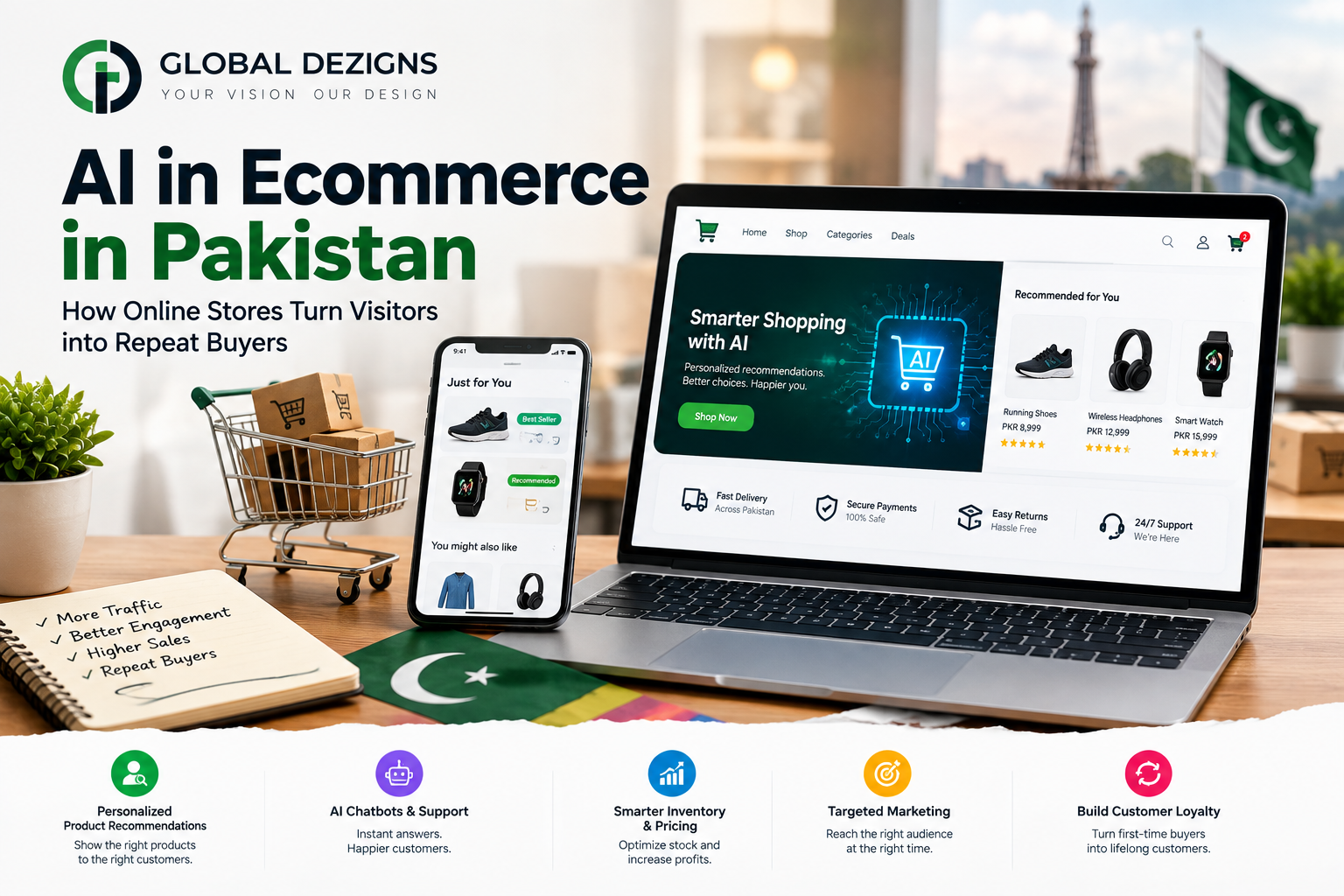
1. Why AI Is the New Battleground for Online Retail
Walk into any Karachi showroom and the salesperson remembers your name, knows what you bought last time and suggests the exact colour you were eyeing. That personal touch is what keeps customers coming back. AI in ecommerce does the same thing for an online store — at scale, in milliseconds, for thousands of visitors at once.
Globally, AI has moved from a buzzword to a measurable revenue driver. Ecommerce players using AI-driven personalisation consistently report double-digit lifts in conversion, and the economics are documented by firms like McKinsey, which estimates AI-driven personalisation can cut acquisition costs by up to 50% and lift revenue by 5–15%. The Stanford AI Index tracks the same trend: retail and ecommerce sit among the top sectors for AI adoption worldwide.
The gap in Pakistan is wide open. Most local online stores still run on manual processes — admin staff typing product descriptions, cashiers reconciling Cash on Delivery (COD) sheets by hand, marketers guessing which audience to target. Meanwhile, customers on Daraz and Instagram shops are already used to curated feeds. The stores that close that gap first will own their niche.
2. The Pakistani Ecommerce Problems AI Actually Solves
Before recommending technology, it helps to name the real pains Pakistani online sellers face every week:
- Cart abandonment is brutal. Shoppers browse on mobile, get distracted, and never return. Many stores recover zero of those lost carts.
- COD is king — and costly. A large share of orders in Pakistan are Cash on Delivery, and with it comes fake orders, non-delivery, returns and reconciliation headaches. Industry-wide, COD return rates in South Asia routinely hit 20–40%.
- Pricing is guesswork. Owners set margins by instinct, leaving money on the table during Ramadan rushes and losing sales to competitors during off-peak weeks.
- Inventory either rots or runs out. Without demand signals, stores overstock slow movers and stock out of bestsellers — the classic profit killer we cover in AI inventory management for Pakistani businesses.
- Support is a single phone. One person answering WhatsApp messages from 9am to midnight cannot keep up, and slow replies cost sales.
- Marketing is spray-and-pray. Without customer data, ad budgets go to broad audiences instead of people likely to buy.
Every single one of these is a machine-learning problem. That is the key insight: AI does not replace your store — it replaces the guesswork in your store.
3. 7 AI Use Cases That Pay for Themselves
🛒 1. Product Recommendations & Personalisation
On your product page, one template serves every visitor. AI serves each visitor a different store: the customer who bought a baby cot sees strollers and nappies; the one who bought a phone sees tempered glass and chargers. Recommendation engines learn from browsing history, past orders and behaviour patterns, presenting "frequently bought together," "customers also viewed" and email follow-ups. This single feature drives a large share of ecommerce revenue growth globally — and it works even harder in markets with thin catalogues where every visitor matters.
💬 2. AI Chatbots on WhatsApp & Your Site
Pakistan's customers live on WhatsApp. An AI chatbot answers order status queries, tracks shipments, collects missing addresses, suggests products and even handles complaints — 24/7, in Urdu, Roman Urdu and English. This is such a powerful fit for local businesses that we wrote a dedicated guide on WhatsApp AI chatbots for Pakistani businesses; most stores recover the chatbot cost within weeks purely from orders that would otherwise be lost after office hours.
💰 3. Dynamic Pricing
AI watches demand, competitor prices, season and stock levels, then suggests the right price for each product each day. Your bestseller during Eid rush can command the right margin; last season's stock drops automatically to clear before you pay warehousing on it. Dynamic pricing alone typically lifts gross margin by several points — money that goes straight to the bottom line.
📦 4. Demand Forecasting & Smart Reordering
Machine-learning models read your sales history against calendar events — Ramadan, Eid, winter, load-shedding hours — and predict what will sell next week. The system tells you exactly how many units to reorder and when, so you stop tying up cash in dead stock and stop losing bestseller sales. For a deeper dive on this, see our AI inventory management guide with Pakistani use cases.
🛡️ 5. COD Fraud & Fake Order Detection
This is the hidden bleeding wound of Pakistani ecommerce. AI scores every order for fraud risk using hundreds of signals — ordering history, device fingerprints, address patterns, order velocity, delivery zone performance. High-risk orders get flagged for prepayment or verification before they go to the courier. Stores routinely cut COD losses by a third or more within the first few months, which often pays for the whole AI stack.
📣 6. AI-Powered Content, SEO & Ad Targeting
Writing 500 product descriptions by hand is why most catalogues stay half-empty. AI generates SEO-ready descriptions, titles and image alt text in bulk — then keeps ranking them. On the ad side, machine learning finds lookalike audiences from your existing buyers instead of blasting broad targeting. Combined with solid digital marketing services in Karachi, this is where AI produces the fastest visible ROI for most stores.
🔁 7. Cart Abandonment Recovery
A visitor adds items, hesitates, leaves. AI identifies that shopper, figures out the likely reason (shipping cost, no COD option, distracted) and triggers the right nudge — a WhatsApp reminder, a discount offer, a stock-shortage warning — at the right moment. Recovering even 10% of abandoned carts is often pure profit, because the marketing cost was already spent.
💡 Start-up frame: you do not need all seven at once. Most Global Dezigns builds start with chatbot + COD fraud scoring + abandoned-cart recovery — the three with the fastest payback — then layer recommendations and dynamic pricing after the data accumulates.
4. Store Without AI vs. Store With AI
| Business Activity | Traditional Store | AI-Enhanced Store |
|---|---|---|
| Product suggestions | None — same page for everyone | Personalised per visitor, per visit |
| Customer support | One person, office hours only | 24/7 chatbot on WhatsApp + site |
| Pricing | Fixed margins set by instinct | Daily demand-aware pricing |
| Order verification | Manual calls to verify COD orders | Automatic fraud risk scoring |
| Abandoned carts | Lost forever | Automated recovery nudges |
| Stock decisions | Reordered when shelves empty | Forecast-driven reordering |
| Catalogue content | Handwritten, half-empty | Bulk AI-generated, SEO-ready |
| Ad targeting | Broad audiences, guessing | Lookalikes built from real buyers |
5. How to Start Small: A 4-Step Roadmap on a Local Budget
- Fix your data foundations first. AI needs clean data. Consolidate your orders, products and customers into one system — if your current platform cannot export clean data, this is the moment to rebuild your ecommerce website with a proper backend rather than patch over it.
- Pick one high-pain use case. Start with the pain that costs you the most money: usually COD fraud or cart abandonment. One well-implemented AI feature beats five half-integrated ones.
- Use cloud AI services instead of building from scratch. Recommendation engines, fraud scoring and chatbot brains are available as services today — you do not need a research team. A development partner wires them into your store, your payment gateways and your courier integrations.
- Measure, then expand. Track conversion, return rate and revenue per visitor for 60–90 days, then add the next layer. AI compounds: the more data your store collects, the sharper every model gets.
Looking for the right foundation partner? Global Dezigns provides custom software development in Karachi and Pakistan and can build the entire stack — storefront, AI layer, courier and payment integrations — under one roof.
6. What Returns Look Like in Real Numbers
Exact figures depend on catalogue size and traffic, but conservative expectations for a Pakistani store doing serious volume:
- COD fraud & returns: cutting return rates from 30% toward 15% on a Rs 5 million monthly order value saves roughly Rs 750,000 a month in courier, verification and restocking costs.
- Cart abandonment recovery: recovering 10–15% of abandoned carts at typical order values is generally equivalent to a 3–6% pure revenue gain, with zero extra acquisition spend.
- Chatbot support: one chatbot answering 60% of routine queries replaces a full-time support salary while replying in under a second.
- Dynamic pricing: 2–5 points of gross margin is common on catalogues with perishable or seasonal stock.
These are not optimistic fiction — the same mechanics are documented across retail AI research tracked by McKinsey and the Stanford AI Index. The Pakistani market simply adopts them later — which means the first movers in each niche enjoy the biggest advantage. Digital payment modernisation by the State Bank of Pakistan (Raast, faster settlements) also makes AI-driven checkout flows more practical now than even two years ago.
7. Frequently Asked Questions
Q1: Is AI in ecommerce affordable for a small Pakistani store?
Yes. Most AI features now run as cloud services priced per usage. A chatbot and fraud-scoring layer typically cost a small monthly fee plus integration — well within reach of any store doing steady volume, and usually self-funding through recovered losses within weeks.
Q2: Do I need to replace my existing ecommerce website?
Not necessarily. If your platform exposes its data and has APIs, AI features can often be layered on top. But if your current store is a static template with no clean data export, upgrading the foundation first (as covered in our ecommerce development services) is the better investment.
Q3: Can AI handle Urdu and Roman Urdu for Pakistani customers?
Yes. Modern language models handle Urdu, Roman Urdu and code-mixed chat naturally. Our Urdu AI guide for Pakistani businesses explains exactly where local-language AI works best.
Q4: How long does it take to see results?
Fraud detection and chatbots show savings from day one. Recommendations and dynamic pricing need 4–8 weeks of data to sharpen. Overall, most stores see measurable improvement in conversion or return rates within the first quarter.
Q5: What if my store is on Shopify, Magento or a custom build?
All three work. AI layers integrate via APIs on any platform with a proper backend. For Magento-based stores specifically, see our Magento development services in Karachi.
Q6: Is my customer data safe with AI systems?
Data security depends on the setup, not the AI itself. A reputable developer keeps customer data on your servers, applies encryption and access controls, and signs a clear data-processing agreement. Ask for these in writing before any vendor touches your data.
8. Conclusion
Pakistani ecommerce no longer competes on having a website — every serious brand has one. The new edge is in what happens after a visitor lands: personalisation that reads intent, support that never sleeps, pricing that responds to demand, and fraud checks that stop losses before they ship. AI in ecommerce turns your store from a shop window into a learning machine — and the stores that start collecting that advantage now will define their niches before competitors catch up.
View All Blogs