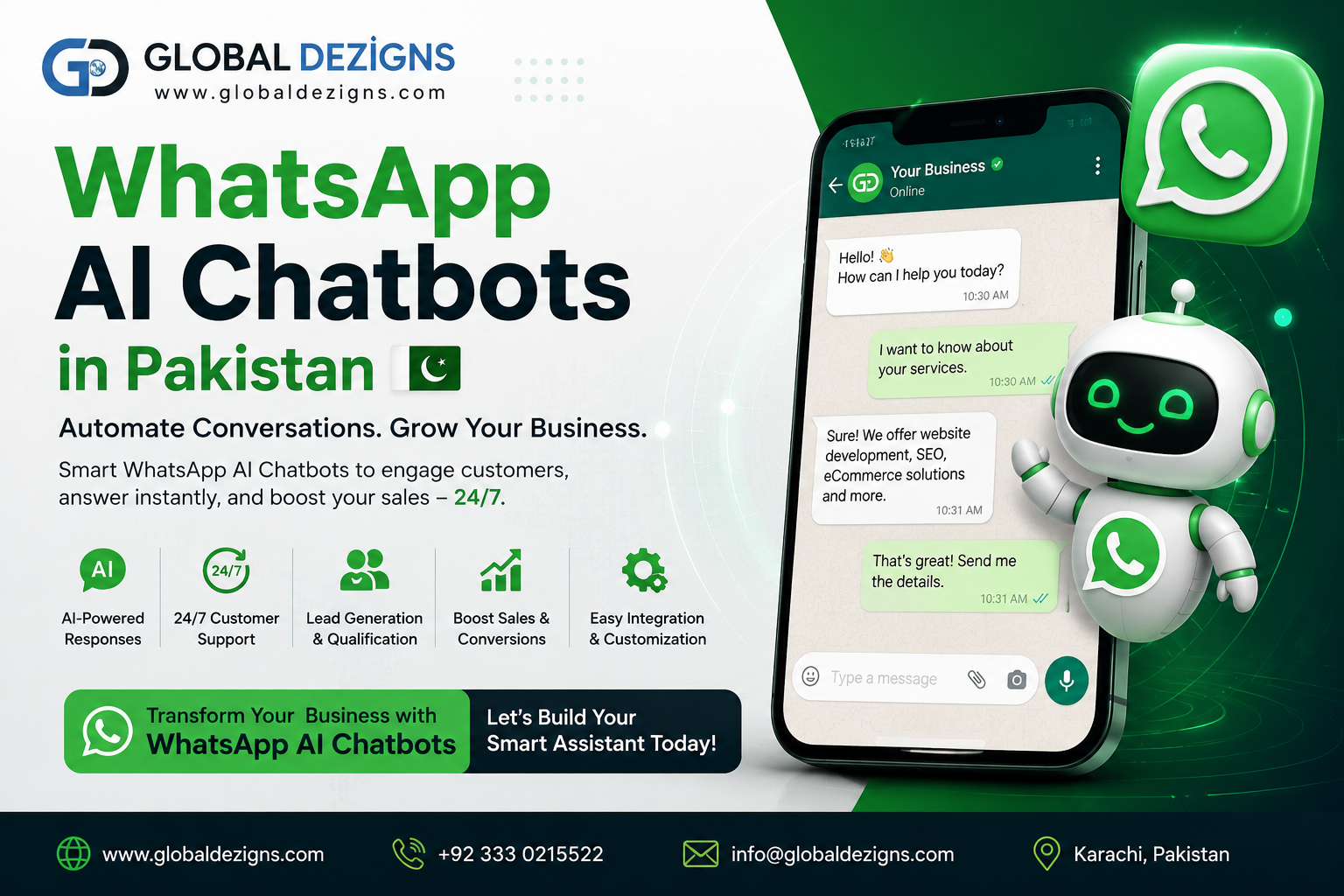
Pakistan is one of the most WhatsApp-dependent markets in the world, and that habit has quietly turned into a business channel. Banks, telecom operators, online retailers, and healthcare providers are increasingly routing customer conversations through WhatsApp — and a growing share of those conversations are now handled, at least in part, by AI-powered chatbots rather than human agents.
This guide explains what WhatsApp AI chatbots are, how Pakistani businesses across different sectors are actually using them, what the technology can and cannot do well, and what local businesses need to know about compliance before rolling one out.
Quick summary: WhatsApp AI chatbots combine Meta's WhatsApp Business API with natural-language AI to automate customer conversations at scale. In Pakistan, adoption is heaviest among banks, telecom operators, and e-commerce brands, who use them for balance checks, order updates, and round-the-clock support. Pakistan currently has no enacted data protection law, so businesses deploying these tools rely on the Prevention of Electronic Crimes Act (PECA) and sector-specific rules from the State Bank of Pakistan (SBP) and Pakistan Telecommunication Authority (PTA) for compliance.
Why WhatsApp Is Pakistan's Default Business Communication Channel
Pakistan had more than 117 million internet users by late 2025, according to DataReportal's Digital 2026: Pakistan report, compiled with Kepios — equivalent to 45.6% of the population. Cellular mobile connections stood even higher, at around 194 million, or 75.9% of the population, though many of these are voice/SMS-only connections rather than full mobile broadband subscriptions.
WhatsApp-specific user estimates vary considerably depending on the source and methodology, ranging from roughly 50 million to over 100 million active users. Rather than lean on a single contested figure, independent behavioral data offers a clearer picture: nationally representative polling by Gallup Pakistan found that 55% of Pakistani adults had used WhatsApp the previous day, a figure that climbed to 61% among urban residents and 58% among men. Pakistan also consistently ranks among the top countries worldwide for WhatsApp Business app downloads — a strong signal that Pakistani businesses, not just consumers, have already made WhatsApp part of daily operations.
For businesses, this matters because WhatsApp is no longer a supplementary channel. For a large share of customers, it is the preferred — or only — way they expect to reach a company.
What Exactly Is a WhatsApp AI Chatbot?
A WhatsApp AI chatbot is software that automatically interprets and responds to customer messages on WhatsApp using artificial intelligence, rather than a human agent typing each reply. It's worth separating two things that often get conflated:
The WhatsApp Business App: is Meta's free app for small businesses. It supports basic automated greetings, away messages, and quick replies, but it's built for a single user on a single device and doesn't scale to high message volumes or multiple agents.
The WhatsApp Business API: is Meta's platform for larger-scale, programmatic messaging. It isn't a consumer app at all — businesses access it through Meta-authorized Business Solution Providers (BSPs), which layer chatbot builders, CRM integrations, and analytics on top of it. This is the layer genuine AI chatbots run on, and it is effectively mandatory for any business handling meaningful message volume, multiple support agents, or regulated customer data, since it supports audit trails, role-based access, and integration with existing systems.
The “AI” part typically refers to natural-language understanding: instead of forcing customers through rigid button menus, the chatbot interprets free-text messages — increasingly in Urdu as well as English — identifies intent, and either answers directly, pulls data from a connected system such as a core banking platform or e-commerce catalog, or hands the conversation to a human agent when the query falls outside its scope.
How Businesses Are Using WhatsApp AI Chatbots In Pakistan
Adoption is broadest in a handful of sectors where a small number of recurring queries account for a large share of total support volume.
Banking and Fintech
Pakistani banks were early, aggressive adopters. Habib Bank Limited (HBL), one of the country's largest banks, offers WhatsApp banking that lets customers check balances, transfer funds, generate IBANs, and top up mobile accounts directly through a chat interface. Other major banks run similar services for balance inquiries, transaction alerts, and initial complaint logging — use cases well suited to automation because they are high-volume, low-risk, and rarely require judgment calls.
Telecom
Mobile network operators use WhatsApp chatbots to handle bill inquiries, package activations, and data-balance checks — queries that would otherwise flood call centers. This is one of the highest-volume applications in the country, simply because of how often prepaid users check balances and buy bundles.
E-Commerce Website and Retail
Online retailers use WhatsApp AI chatbots to answer product questions, share catalogs, confirm orders, send shipping updates, and process return requests, often integrated directly with platforms like Shopify. Reducing “where is my order” messages is one of the most commonly cited wins, since it is a high-volume, repetitive query that doesn't need a human touch.
Healthcare
Clinics and hospitals increasingly use WhatsApp chatbots for appointment booking, lab-result notifications, and prescription-refill reminders. Because health data is sensitive, provider selection and data-handling practices matter more here than in most other sectors.
Real Estate and Education
Real estate agencies use chatbots for initial lead qualification and site-visit scheduling, while schools, colleges, and ed-tech platforms use them to manage admissions queries and student support at scale — particularly valuable during high-volume admission cycles.
The Urdu-Language Shift: Why Local-Language AI Matters
A major limitation of earlier chatbot deployments in Pakistan was language. Most AI language models were trained overwhelmingly on English data, so chatbots often struggled with Urdu — and struggled further with the Roman Urdu/English code-switching (“Urdish”) that dominates real WhatsApp conversations in Pakistan.
That started to change in October 2025, when Meta launched ALIF, a dedicated Urdu-language AI model, in partnership with Pakistan's Ministry of Information Technology and Telecommunication (MoITT). Announced at MoITT's “Future in Focus: AI and Innovation” event, the launch allows users to interact with Meta AI in Urdu as well as English and is intended to reduce the language barriers that have limited AI adoption outside English-speaking, urban segments of the population.
For businesses, this matters directly: chatbots built on more capable Urdu-language models can understand a wider range of genuine customer phrasing rather than forcing users into English or into rigid keyword-based menus. Regional languages — Punjabi, Sindhi, Pashto, Balochi — remain far less well supported, so businesses serving those audiences should test language handling carefully before launch rather than assuming Urdu-level accuracy will carry over.
Key Benefits for Pakistani Businesses
- Round-the-clock availability: Chatbots don't observe office hours, which matters in a market where a large share of WhatsApp activity happens in the evening.
- Lower cost per interaction: Automating repetitive, high-volume queries — balance checks, order status, bill inquiries — frees human agents for conversations that genuinely need judgment.
- Faster response times: Instant replies reduce the frustration that comes with long queue times on phone-based support.
- Scalability without proportional headcount growth: A well-built chatbot can absorb an Eid sales spike or a network-outage surge in complaints without emergency hiring.
- A channel customers already trust: Because WhatsApp is already how people talk to friends and family, businesses meet customers where they are instead of asking them to learn a new app or portal.
Vendors in this space often advertise specific percentage reductions in service volume or cost. These figures are typically self-reported by the provider rather than independently audited, so it's reasonable to treat them as directional rather than guaranteed for any specific business.
Legal and Regulatory Considerations in Pakistan
This is the section most WhatsApp chatbot content skips — and the one that matters most once a business actually deploys one.
Data Protection: A Law Still in Draft
As of mid-2026, Pakistan has no comprehensive, enacted data protection law. A Personal Data Protection Bill has been in development by MoITT since 2018, with a revised 2025 draft circulated for feedback, but it had not been passed into law as of this writing. In its absence, the Prevention of Electronic Crimes Act (PECA) 2016 — substantially amended in January 2025 — is the main statute businesses rely on. PECA is a criminal law aimed at offenses such as unauthorized data access and disclosure; it was not designed as a comprehensive privacy framework, which leaves real gaps around consent, retention, and cross-border data transfer that businesses currently have to address through their own contracts and internal policy rather than statutory requirement.
This gap has real consequences. Pakistan has seen high-profile data-security failures in recent years, including a widely reported 2024 breach that traced leaked personal records of millions of citizens back to insiders at a state database agency. Businesses building customer-facing AI tools on WhatsApp should treat data protection as a genuine operational priority now, not a future compliance requirement to defer.
Sector Regulators: PTA and SBP
Two regulators matter most in practice. The Pakistan Telecommunication Authority (PTA) oversees telecom consumer protection, including complaints about misuse of subscriber data. The State Bank of Pakistan (SBP) regulates banks and other financial institutions directly, and has been notably active recently: it issued a Technology Risk Management Framework for payment institutions in October 2025 (with a compliance deadline of March 31, 2026) covering cyber-risk controls and incident reporting, launched a regulatory sandbox for fintech innovation in late 2025, and has separately been finalizing dedicated guidelines for the responsible use of AI in financial services.
More broadly, Pakistan's National Artificial Intelligence Policy 2025 — a six-pillar framework covering AI innovation, infrastructure, and sectoral adoption, backed by a dedicated National AI Fund — signals government-level commitment to AI growth, even though it does not set specific operating rules for consumer-facing tools like WhatsApp chatbots.
What This Means in Practice
Businesses, particularly in banking, fintech, and healthcare, should not wait for the Personal Data Protection Bill to pass before building good data-handling practices into their WhatsApp AI chatbot deployment. Practical steps include documenting what customer data the chatbot collects and where it is stored, confirming the chosen provider's data-hosting and security practices in writing, limiting data collection to what the chatbot genuinely needs, and assigning clear internal accountability for data-related issues.
Challenges and Limitations to Plan For
- Legal uncertainty: Operating without a finalized data protection law means compliance today rests on good practice and sector rules rather than one clear standard — and this can change with limited notice.
- Language coverage gaps: Urdu handling has improved meaningfully, but regional languages and heavily mixed-script messages can still trip up even well-built chatbots.
- Connectivity gaps: With internet penetration still under half the population, a WhatsApp-only strategy can exclude a meaningful share of potential customers, particularly in rural areas.
- Over-automation risk: Sensitive conversations — a disputed bank transaction, a serious health question — need a clear, fast path to a human agent. Businesses that automate too aggressively risk real customer frustration.
- Approval friction: Message templates sent outside the 24-hour customer-service window need Meta's prior approval, which can slow campaign launches if not planned for in advance.
How to Choose a WhatsApp AI Chatbot Provider in Pakistan
Because the WhatsApp Business API is only accessible through Meta-authorized partners, provider selection is a real decision, not a formality. Before signing on, businesses should verify:
- Meta Business Partner status: A legitimate provider should be listed in Meta's official Business Partner directory — ask for this directly rather than taking it on faith.
- Template approval track record: Ask how quickly and reliably the provider gets message templates approved, since this affects how fast new campaigns and flows can go live.
- Data hosting and security practices: Given the current legal gap described above, a business's own diligence has to substitute for regulation — ask specifically where data is stored and who can access it.
- Local billing and support: Providers that bill in PKR avoid exposing the business to exchange-rate risk, and local support matters when something breaks outside standard hours.
- Genuine AI capability versus keyword matching: Some “AI chatbots” are really rule-based keyword bots with limited flexibility. Ask for a live demo using real, messy customer phrasing — including Urdu and mixed-language messages — rather than a scripted one.
Frequently Asked Questions
Is the WhatsApp Business API free in Pakistan?
No. The basic WhatsApp Business App is free, but the WhatsApp Business API involves Meta's own conversation-based charges plus a fee from whichever Business Solution Provider supplies the chatbot platform and support.
Do businesses need Meta's approval to run a WhatsApp chatbot?
Yes. Businesses must complete Meta's business verification process to access the API, and any message template used outside the 24-hour customer-service window requires prior approval from Meta.
Is it legal to collect customer data through a WhatsApp chatbot in Pakistan?
There is no law that bans it, but there is also no comprehensive data protection statute governing how it must be handled. Businesses currently operate under PECA and sector-specific rules from the SBP or PTA, depending on the industry, and should apply strong data-handling practices voluntarily rather than waiting for the Personal Data Protection Bill to pass.
Can a WhatsApp chatbot reply in Urdu?
Yes, and accuracy has improved substantially since Meta launched its dedicated Urdu AI model, ALIF, in October 2025. Regional languages such as Punjabi, Sindhi, Pashto, and Balochi remain less well supported, so this should be tested before launch if relevant to the target audience.
How much does a WhatsApp AI chatbot cost for a small business in Pakistan?
It depends on message volume, the complexity of the chatbot's logic, and the provider chosen — there is no fixed market rate. Businesses should request itemized quotes covering Meta's conversation fees, the provider's platform fee, and any custom setup work, rather than relying on a single advertised price.
The Road Ahead
A few developments are likely to shape this space over the next year or two. The Personal Data Protection Bill will probably move closer to passage, which would tighten compliance obligations for any business processing customer data through WhatsApp. SBP's forthcoming AI guidelines for financial services should set more specific expectations for banks and fintechs using AI-driven customer service. And continued improvement in Urdu — and eventually regional-language — AI capability should make chatbots noticeably better at handling how Pakistani customers actually write, rather than how a chatbot expects them to write.
Conclusion
WhatsApp AI chatbots have moved from novelty to standard infrastructure for customer-facing Pakistani businesses, driven by the sheer scale of WhatsApp usage in the country and by real, measurable gains in response time and support capacity. But the technology is only half the story: businesses that treat data handling and provider vetting as seriously as they treat the chatbot's conversational design will be far better positioned as Pakistan's regulatory landscape catches up with its adoption curve.
Sources
- DataReportal, Digital 2026: Pakistan (compiled with Kepios)
- Gallup Pakistan, WhatsApp usage survey data
- State Bank of Pakistan (SBP) — Digital Financial Services and Technology Risk Management Framework
- Dawn — “Regulations for AI use in banks on the cards”
- Arab News Pakistan — coverage of Meta's ALIF Urdu AI launch (October 2025) and Pakistan's National AI Policy 2025
- Recording Law — Pakistan Data Privacy Laws guide (2026)
