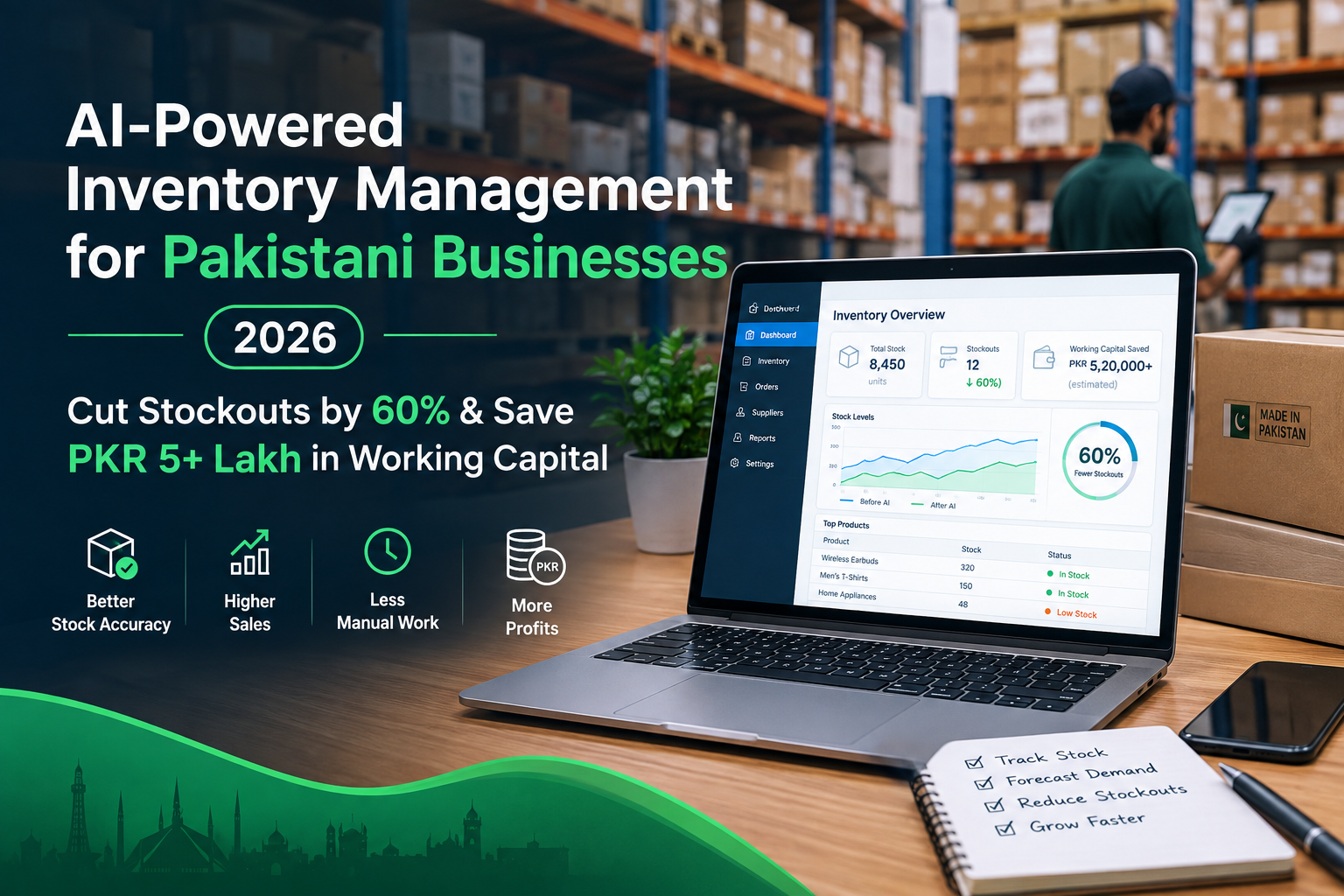
AI-Powered Inventory Management for Pakistani Businesses 2026 — Cut Stockouts by 60% & Save PKR 5+ Lakh in Working Capital
Quick answer: Pakistani SMEs deploying AI inventory management in 2026 are seeing 25-35% reduction in excess stock, 20-60% fewer stockouts, and freeing PKR 5-15 lakh in working capital within the first year. The catch: you need at least 6-12 months of historical sales data, and most off-the-shelf ERPs in Pakistan still don't ship with real AI — you have to add it as a layer or build it in.
Why AI Inventory in 2026 (and Not 2023)
Three forces have converged to make 2026 the tipping point for AI inventory management in Pakistan — and they didn't exist together before:
- Models are usable. The hallucination tax that plagued AI forecasting two years ago is largely solved for narrow domains like demand prediction. McKinsey's 2025 State of AI report found 67% of supply chain leaders now rank AI agents as a top-three investment priority for 2026.
- Data infrastructure has caught up. Most Pakistani retailers and wholesalers have moved from paper registers to cloud POS or basic ERP. The 6-12 months of historical sales data that AI models need is finally available.
- Pakistan-specific tools exist. A few years ago, AI inventory meant importing a US tool and trying to fit it to Pakistani SKUs, supplier patterns, and load-shedding realities. Today, local vendors like Global Dezigns build AI features into Pakistan-specific systems — pharmacy, transport, retail, export — that understand local reality.
The result: what was theoretical in 2023 is now a competitive necessity. If your competitor has AI-driven auto-reorder and you don't, they will simply never run out of stock when you do.
What AI Inventory Management Actually Does
Forget the buzzwords. Here's the closed-loop workflow that runs in a modern AI inventory system:
- Sense — continuous monitoring of stock positions, sales velocity, supplier lead times, and external signals (weather, promotions, market trends, festivals like Eid/11.11)
- Reason — machine learning models predict future demand at SKU level, factoring in seasonality, lead-time variance, and cross-SKU cannibalization
- Decide — the system recommends (or automatically executes) replenishment orders, stock transfers between locations, and pricing adjustments for slow-movers
- Act — triggers supplier API calls, places purchase orders, reallocates stock between warehouses, alerts humans only for exceptions
The biggest shift from old-school inventory software: AI predicts and acts instead of just recording and reporting. A 2026 AI system doesn't show you a stockout after it happens — it warns you 2-3 weeks before.
Six concrete AI features that pay for themselves
- Demand forecasting — per-SKU, per-location, per-week predictions (vs. gut feel or static "min/max" rules)
- Auto-reorder — generates draft purchase orders when stock falls below the AI-calculated safety threshold
- Anomaly detection — flags duplicate POs, unusual shrinkage, cost variances between invoice and recorded price
- Lead-time prediction — uses actual supplier history (not their quoted "5-day delivery") to set realistic reorder points
- Cross-channel sync — prevents overselling when the same SKU is listed on physical shop + Facebook + WhatsApp + website
- Expiry & dead-stock alerts — critical for pharmacies and FMCG; AI catches what humans miss
Real Numbers — The 2025-26 Data
Not vendor claims — published research:
| Metric | Source | Result |
|---|---|---|
| Excess inventory reduction | Gartner 2025 supply chain survey | 25-35% within 12 months |
| Order fill rate improvement | Gartner 2025 supply chain survey | 20% within 12 months |
| Stockout reduction | a8gent.com 2026 industry report | 40-65% |
| Overstock reduction | a8gent.com 2026 industry report | 30-50% |
| Customer service agent payback | Bain Agentic AI Benchmark 2026 | 4.1 months median |
| Backend supply chain agent payback | Bain Agentic AI Benchmark 2026 | 9.3 months median |
| AI agents as top-3 priority | McKinsey 2025 State of AI | 67% of supply chain leaders |
For a Pakistani SME carrying PKR 50 lakh in inventory, a 30% overstock reduction = PKR 15 lakh freed. A 50% stockout reduction on PKR 20 lakh annual lost sales = PKR 10 lakh recovered. Combined first-year impact: PKR 15-25 lakh — against a software cost of PKR 3-15 lakh.
Pakistan-Specific Opportunities
Generic AI inventory guides miss what makes Pakistan unique. Here are the four factors that change the math:
- Festival-driven demand spikes. Eid, 11.11, wedding season (Nov-Feb), back-to-school (Aug-Sep) — AI models trained on Pakistani data learn these patterns automatically. Off-the-shelf global tools miss them.
- Load-shedding realities. AI systems must support offline mode. POS records transactions locally; sync happens when connectivity returns. A pure cloud-only solution fails in Tier-2/3 cities.
- PKR volatility. When you reorder in dollars (imported goods) but sell in rupees, holding too much inventory is a currency risk. AI that triggers smaller, more frequent orders reduces exposure.
- Multi-channel fragmentation. Many Pakistani retailers sell on physical shop + Daraz + Facebook + Instagram + WhatsApp. Manual sync is impossible at scale. AI cross-channel sync prevents the most common complaint: "I sold it on Facebook but the shop ran out."
This is why local software houses like Global Dezigns have an edge — they build the AI features into Pakistan-specific products like Pharmacy Store Management, Transport Management, and ERP solutions.
Industries That Benefit Most
Not every business needs AI inventory. Here are the profiles where the ROI is strongest:
| Industry | Why AI Wins | Typical Annual Benefit |
|---|---|---|
| Pharmacy chains | Medicine expiry + demand spikes during flu season + 1000s of SKUs | PKR 8-15 lakh from expiry reduction alone |
| Retail chains (multi-location) | Stock transfer optimization + per-location demand variation | PKR 5-20 lakh working capital |
| Wholesalers & distributors | Large SKU counts + supplier lead-time variability | PKR 10-30 lakh working capital |
| FMCG / grocery | Perishables + festival demand + tight margins | 5-15% margin improvement |
| E-commerce & D2C brands | Multi-channel stock sync + return-rate optimization | 40-60% stockout reduction |
| Auto parts & electronics | Long lead times + model-year obsolescence | PKR 15-40 lakh dead-stock reduction |
| Manufacturers | Raw material + finished goods + supplier reliability | 15-25% working capital freed |
The single biggest signal: if you carry PKR 20 lakh+ in inventory and lose sales to stockouts monthly, AI inventory will pay for itself in 4-9 months. The Bain Agentic AI Benchmark 2026 confirms this — backend supply chain agents have a 9.3 month median payback.
Build vs Buy vs Add-On — Which Path Fits You
Three ways to get AI inventory in 2026, with honest tradeoffs:
1. Buy — Use a Pakistan-built ERP/POS that already has AI features
Best for: SMEs on legacy or no software, wanting fastest ROI. Global Dezigns' pharmacy, transport, ERP, and POS systems are examples.
- Pros: Fast deployment (2-6 weeks), Pakistan-specific, local support, integrated with existing modules (accounts, CRM)
- Cons: You're locked to the vendor's roadmap; custom features may be limited
- Cost: PKR 25,000-150,000/month all-in
2. Add-on — Keep your existing software, add an AI layer on top
Best for: Businesses with working ERP/POS that doesn't have AI, but a 2-3 year replacement isn't justified.
- Pros: No rip-and-replace, modular, you can swap the AI layer later
- Cons: Integration complexity, double the maintenance (existing software + new layer)
- Cost: PKR 50,000-200,000/month for the AI layer + integration cost
3. Build — Custom AI inventory system from scratch
Best for: Mid-size to large businesses with unique workflows, multiple SKUs in millions, or strict data residency requirements.
- Pros: Tailored exactly to your process, no vendor lock-in, IP ownership
- Cons: 3-6 months development, PKR 800K-3M+ initial, requires in-house data team or trusted partner
- Cost: PKR 800K-3M one-time + PKR 100-300K/month maintenance
For 80% of Pakistani SMEs, the "Buy" path is the right call — you get Pakistan-specific features, local support, and ROI in months, not years. The exceptions are businesses with genuinely unique workflows or those processing inventory data at massive scale.
Implementation Roadmap (90 Days)
A realistic 90-day plan for a mid-size Pakistani business going from manual to AI-driven inventory:
Days 1-15: Discovery & Data Audit
- Pull 12-24 months of sales data (or as far back as you have)
- Clean SKU master data — fix duplicates, fix units, fix naming
- Map current workflow: who orders, when, from whom, how long does delivery take
- Choose your path (buy / add-on / build)
Days 16-45: System Setup & Data Migration
- Deploy or set up the chosen system
- Import historical sales, supplier list, current stock, customer data
- Configure reorder thresholds (initially manual, AI will learn)
- Train 2-3 staff members on the new system
Days 46-75: Parallel Run & AI Calibration
- Run old process + new system in parallel
- AI makes recommendations; humans approve or override
- Track override rate — high override rate = AI needs more training data or different rules
- Document edge cases and exceptions
Days 76-90: Go Live & Optimize
- Switch to AI-driven mode for low-risk SKUs (slow-movers, non-perishables)
- Keep human approval for high-value or high-risk SKUs
- Set up weekly review of AI performance
- Measure: stockout rate, dead stock %, working capital tied up
Common mistake: trying to switch 100% to AI on day 1. The 90-day parallel-run phase exists for a reason. AI inventory systems get dramatically better in months 2-6 as they learn your specific patterns.
Real 2026 Cost & ROI Benchmarks
| Business Size | Monthly Cost (PKR) | First-Year Benefit | Payback |
|---|---|---|---|
| Small retailer (50-200 SKUs) | 15,000-40,000 | PKR 3-8 lakh | 4-8 months |
| Mid-size retailer (200-2,000 SKUs) | 40,000-100,000 | PKR 8-25 lakh | 3-6 months |
| Pharmacy chain (5-20 branches) | 80,000-200,000 | PKR 15-50 lakh | 3-5 months |
| Wholesaler / distributor (5,000+ SKUs) | 100,000-300,000 | PKR 25-80 lakh | 2-4 months |
| Multi-location retail chain | 150,000-400,000 | PKR 40-150 lakh | 2-4 months |
These are conservative ranges based on McKinsey and Gartner benchmarks, scaled to Pakistani PKR and adjusted for typical Pakistani SME margins.
10-Point Vendor Scorecard
Print this. Score every vendor 0/1/2. Under 14/20 is a "no":
AI capability (0-2 each)
- Demand forecasting per SKU (not just per category)
- Auto-reorder with human override (not 100% autonomous)
- Anomaly detection (duplicates, shrinkage, cost variances)
- Lead-time prediction using actual supplier history
- Multi-channel stock sync (shop + online + WhatsApp)
Pakistan fit (0-2 each)
- Offline mode for load-shedding hours
- Festival-aware forecasting (Eid, 11.11, wedding season)
- PKR pricing + USD reorder support (currency-aware)
- Local support with WhatsApp response under 4 hours
- On-shore data storage (compliance + latency)
If a vendor scores under 14, walk away. AI inventory without Pakistan-specific features is a global tool that will fail at the first Eid spike.
FAQs
Q: How much does AI inventory management cost in Pakistan in 2026?
A: For Pakistani SMEs, AI inventory features come baked into ERP or pharmacy/POS software for PKR 25,000-150,000/month. Standalone AI platforms start at PKR 30,000/month. Custom AI integration costs PKR 300,000-800,000 one-time.
Q: What is the actual ROI of AI inventory management?
A: McKinsey's 2025 State of AI report found 25-35% reduction in excess inventory and 20% improvement in order fill rates within 12 months. For a Pakistani SME carrying PKR 50 lakh in inventory, that's PKR 12-17 lakh freed in working capital annually.
Q: Which Pakistani businesses benefit most from AI inventory systems?
A: Pharmacies (medicine expiry + demand forecasting), retail chains (multi-location sync), wholesalers (large SKU counts), manufacturers, and e-commerce stores. Any business carrying PKR 20 lakh+ in inventory and losing sales to stockouts.
Q: Do I need to replace my existing software to get AI inventory features?
A: Not necessarily. Many modern Pakistani ERPs/POS now include AI features as add-ons. Custom integrations via APIs can add AI capabilities to legacy software without full replacement.
Q: How long does AI inventory implementation take?
A: A cloud AI module on existing software: 2-4 weeks. A standalone platform for a mid-size retailer: 4-8 weeks. A custom AI-integrated ERP for multi-location business: 3-6 months. You need 6-12 months of historical sales data for accurate forecasting.
Q: Can AI inventory systems work offline?
A: Most require internet for real-time forecasting, but modern Pakistan-built systems include offline POS mode that captures transactions locally and syncs when connectivity returns — critical for load-shedding hours.
📚 Authoritative External References
- McKinsey 2025 State of AI Report — supply chain AI adoption benchmarks
- Gartner 2025 Supply Chain Technology Survey — inventory optimization metrics
- Bain Agentic AI Benchmark 2026 — payback periods by function
- Microsoft Supply Chain Platform — warehouse & inventory AI agents (Feb 2026)
- State Bank of Pakistan — SME working capital & currency context
- Pakistan Software Export Board — local software house directory
