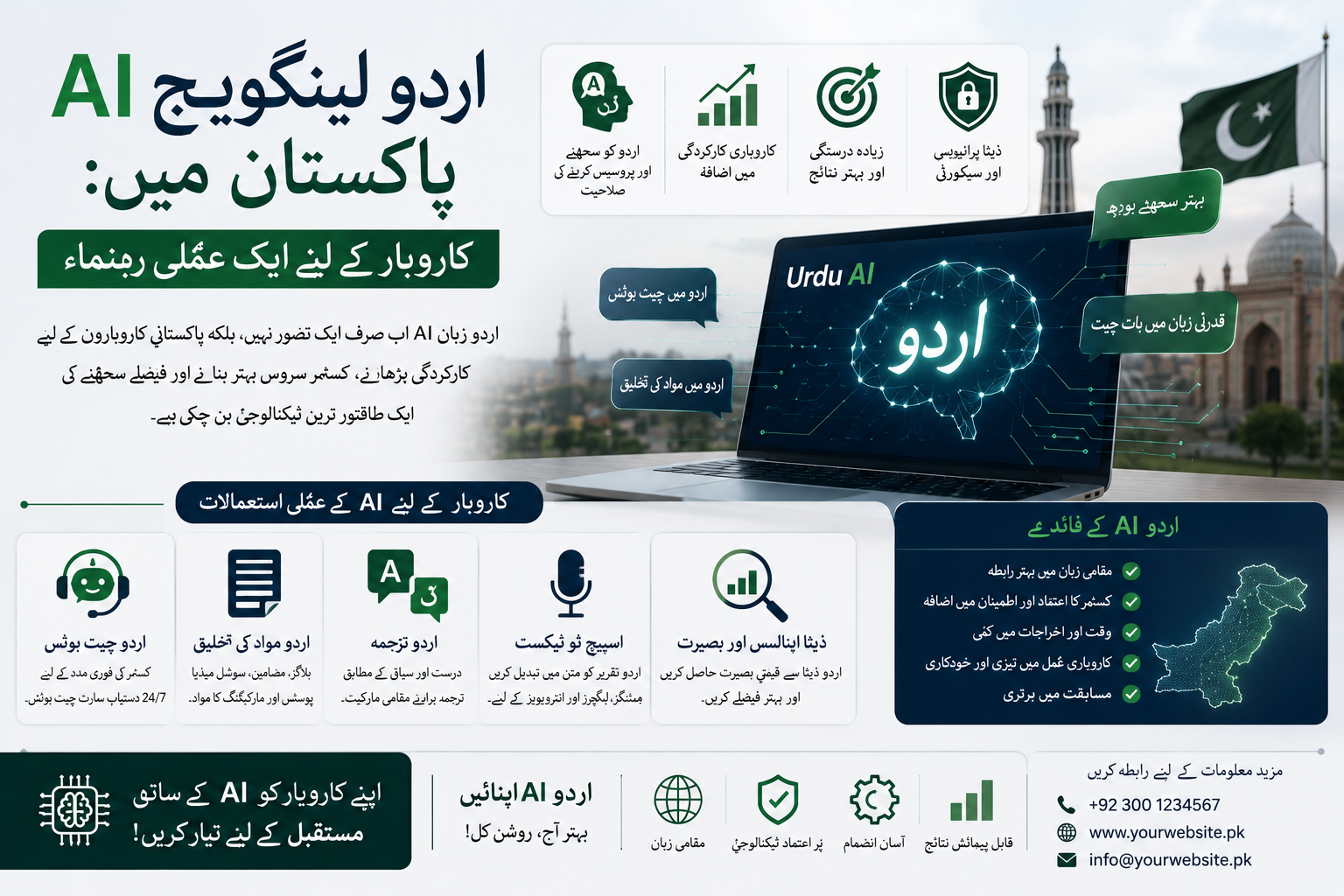
Most artificial intelligence products in Pakistan are built for people who read and type in English. But the reality on the ground is different: a vast share of the country's users — customers, patients, farmers, first-time internet users — communicate in Urdu, Roman Urdu, Punjabi, Sindhi or Pashto. When your AI only understands English, you're silently excluding the majority of the market you claim to serve.
This is the opening for Urdu language AI: systems that understand, speak and respond in the languages Pakistanis actually use. From a custom AI solution built in Karachi to a Roman Urdu WhatsApp bot, local-language AI is moving from research labs into real products. Here's what it means for Pakistani businesses — and why the early movers will own an underserved market.
The Language Gap Holding Back Pakistani Tech
Consider who interacts with software today. A Karachi clinic's booking system assumes English. A farm advisory app assumes the user can read English menus. A government service portal defaults to English or formal Urdu script that rural users struggle with on a phone keyboard. The result:
- Excluded users: Tens of millions who'd benefit from a service but can't navigate its English interface.
- Abandoned funnels: A user who can't phrase a query in English simply leaves — no error, just silence.
- Trust deficit: People trust systems that "speak their language" — literally. An Urdu voice response builds confidence an English one never will.
- Wasted reach: Businesses pour ad budget into campaigns that land on a portal half the audience can't use.
The insight: Language isn't a translation layer you bolt on later — it's the front door. If the door only opens for English speakers, you've already lost most of the room.
What "Urdu Language AI" Actually Means
Local-language AI isn't one thing; it's a stack of capabilities working together:
- NLP for Urdu script: Natural language processing that parses formal Urdu (Nastaliq) text — understanding grammar, context and sentiment.
- Roman Urdu understanding: The messy, phonetic way most Pakistanis type — "ap ka number mil sakta hai?" — which needs its own models because it doesn't follow standard spelling.
- Speech-to-text & text-to-speech: Converting spoken Urdu/Punjabi/Sindhi into text and back into natural voice, crucial for low-literacy users.
- Code-mixing handling: Real conversations mix languages mid-sentence ("bhai ye file upload kar do") — models must not break on this.
- Regional language support: Extending beyond Urdu to Punjabi, Sindhi, Pashto and Balochi for truly inclusive products.
Modern large language models have improved dramatically at multilingual tasks, but production-grade Urdu and regional-language accuracy still needs local training data and tuning — exactly the kind of work a Pakistan-based web and AI application team is positioned to do.
Three Forms Shaping the Local Market
1. Roman Urdu Chatbots
The fastest-adopting form. A WhatsApp or web chatbot that understands and replies in Roman Urdu lets businesses serve customers who'd never type in English. This is already proven in customer support and lead capture use cases across Karachi and Lahore.
2. Urdu Voice Assistants
Voice-first AI for users who can't or won't type — particularly powerful in rural advisory services, banking helplines and healthcare. A farmer asks a question aloud in Punjabi; the assistant answers in Punjabi.
3. Local-Language Document & Content AI
Automated Urdu summarisation, translation between regional languages, and voice-to-document transcription for courts, healthcare and education — turning unstructured local-language data into usable records.
Why This Is a Massive Business Opportunity
The businesses that localise first capture a market competitors ignore:
- First-mover advantage in underserved segments: Rural users, low-literacy customers, and non-English elders are loyal to the first tool that works for them.
- Government & development contracts: Public-service digitisation increasingly demands local-language inclusion — a differentiator for vendors.
- Higher conversion: A user who can ask in their own language completes bookings, applications and purchases far more often.
- Defensible moat: Local-language training data and tuned models are hard for outsiders to replicate quickly.
National digital initiatives run through bodies like the Ministry of Information Technology and Telecommunication (MoITT), which continues to push local-language inclusion in public digital services — creating downstream demand for businesses that can deliver it.
English-First AI vs Local-Language AI
| Dimension | English-First AI | Local-Language AI |
|---|---|---|
| Addressable users in Pakistan | Urban, educated minority | ✅ Majority incl. rural & low-literacy |
| Onboarding friction | High for non-English users | ✅ Near-zero in native tongue |
| Voice accessibility | ❌ Mostly text only | ✅ Speech in Urdu/regional |
| Trust & comfort | Lower for masses | ✅ Higher — "speaks like me" |
| Competitive landscape | ❌ Crowded | ✅ Early, open |
| Data requirement | Abundant public models | ⚠ Needs local tuning |
| Long-term moat | ❌ Easy to copy | ✅ Local data advantage |
The trade-off is real: local-language AI needs more upfront data work. But the payoff is a market most of your competitors simply can't reach.
Example: A Urdu Voice Assistant for Rural Banking
Imagine a microfinance bank serving villages in Sindh and southern Punjab. Most clients are first-time banking users who speak Sindhi or Saraiki, not English, and many are semi-literate. A traditional app fails them; a branch visit costs a full day's wage.
With a local-language voice assistant, a client calls and says in Sindhi, "Meri loan ki status kia hai?" The system transcribes, understands intent, fetches the record, and replies in spoken Sindhi with the status and next step. No English, no typing, no branch trip.
- Call-centre load drops as routine queries self-serve via voice.
- Client trust rises — the bank "speaks their language" literally.
- Financial inclusion metrics improve, opening product upsell paths.
💡 Note: The scenario above is a composite drawn from common financial-inclusion patterns in Pakistan, rounded and anonymised. Real deployments depend on dialect coverage, audio quality and regulatory comfort with voice identity verification.
How Pakistani Businesses Can Build Local-Language AI
Step 1 — Identify the Language Moment
Find where users drop off because of English. Support chats? Voice helplines? Onboarding forms? That's your build target.
Step 2 — Collect Real Local Data
Gather actual Roman Urdu / regional-language phrases your users employ — not translated textbook sentences. This is the single biggest success factor.
Step 3 — Choose the Right Stack
Combine a strong multilingual base model with a local fine-tune, plus speech engines that cover your target dialects. A Karachi-based AI development partner handles model selection and integration.
Step 4 — Integrate Into the User Flow
Embed the assistant into WhatsApp, your web application, or an IVR voice line — wherever users already are.
Step 5 — Measure & Iterate
Track comprehension rate and task completion in the local language; retrain on the errors you see. Accuracy compounds with real usage.
Real Challenges (and Honest Limits)
Local-language AI is powerful but not magic. Be honest about:
- Data scarcity: Punjabi, Sindhi and Pashto labelled datasets are thinner than English — expect more tuning effort.
- Dialect variation: "Punjabi" differs across regions; one model won't perfectly cover all.
- Script input: Nastaliq Urdu on phone keyboards remains awkward; Roman Urdu is often the practical path.
- Accuracy expectations: Set realistic bars — 90% comprehension on common queries, with clean human escalation for the rest.
- Cost of speech: Voice pipelines cost more than text; scope them where voice truly adds value.
None of these are blockers — they're scoping inputs. The businesses that plan around them ship working products; those that ignore them ship demos that frustrate.
Frequently Asked Questions
Can AI really understand Roman Urdu properly?
Yes, far better than a few years ago. The key is training on real Roman Urdu user phrases, not formal translations. A Pakistan-based team collects and tunes on exactly that data.
Which regional languages are most viable today?
Urdu (script and Roman) and Punjabi have the most mature tooling. Sindhi and Pashto are feasible but need more custom data work. Start with the language your highest-value users actually speak.
Is voice AI accurate enough for serious use?
For defined tasks — status checks, FAQs, simple transactions — yes, with clear human escalation. For open-ended or high-risk actions, keep a human in the loop. Set expectations honestly.
How is this different from Google Translate?
Translate converts text between languages; local-language AI understands intent and acts — booking, fetching, replying — in the user's language. It's a capability, not a dictionary.
How long does a local-language AI project take?
A Roman Urdu chatbot: 3–6 weeks including data collection. A multilingual voice assistant: 2–4 months given speech tuning. A local software development team in Karachi scopes this realistically.
What does it cost in Pakistan?
Text-based Roman Urdu bots start around PKR 150,000–400,000 for a tuned production build. Voice and multilingual systems run higher due to speech pipelines and data work. Benchmark against the underserved-market revenue you unlock.
Do we need our own data to start?
Ideally yes — your real customer phrases. If you have none yet, a vendor can bootstrap with public datasets and rapidly improve once live traffic flows. The first month of real data is gold.
