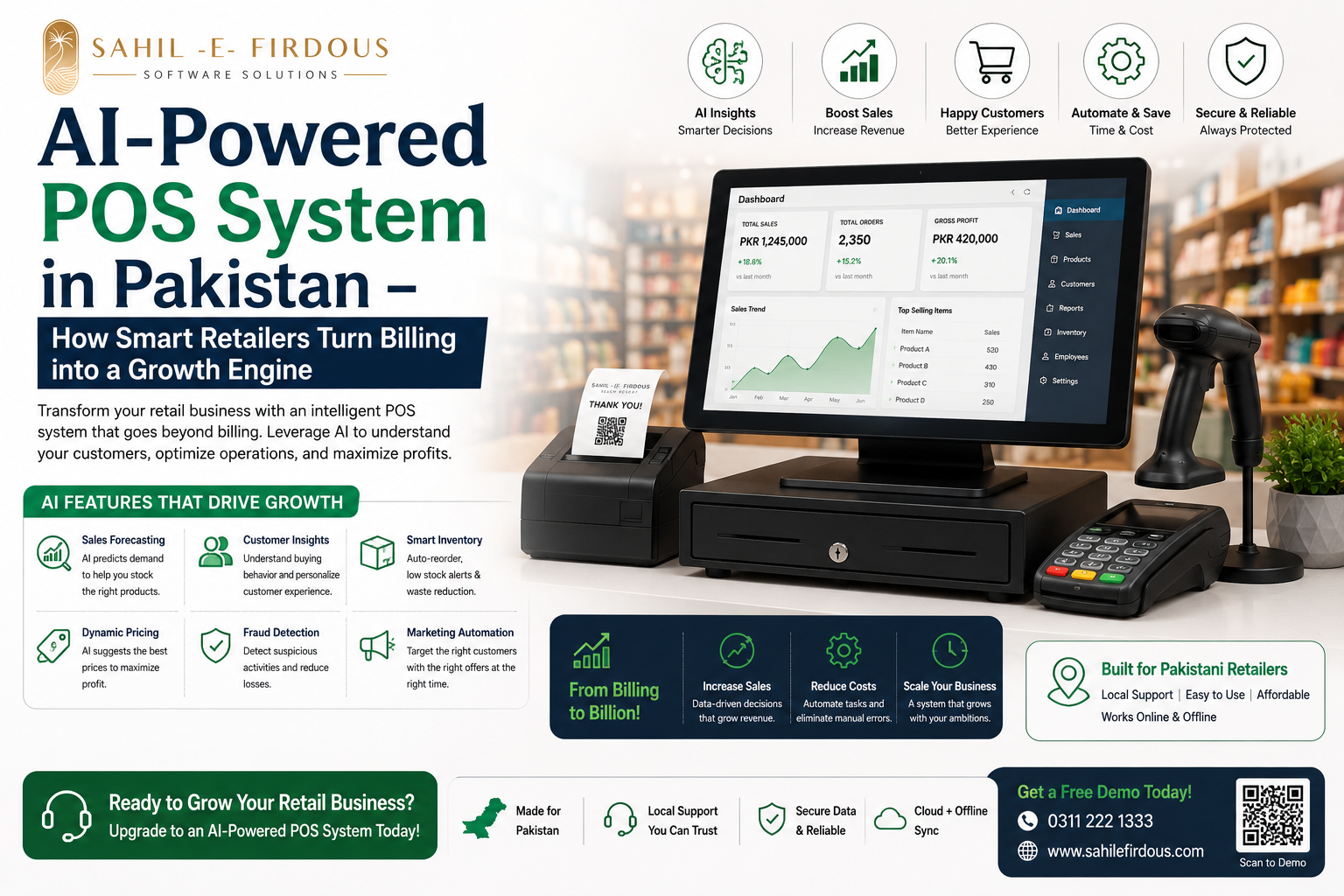
1. Traditional POS vs. AI-Powered POS
For most retailers in Karachi, Lahore and Islamabad, a POS system in Pakistan means one thing: billing. The cashier scans items, the receipt prints, the day's sales are logged. It is faster than a manual register — and that is where it stops.
An AI-powered POS system still bills in seconds, but it does something far more valuable in the background: it learns. Every sale becomes training data. The system studies which products sell together, which hours are busiest, which items are about to expire, and which customers buy most. Then it acts on that knowledge automatically — forecasting stock, suggesting prices, flagging theft and sending purchase orders before you even notice the shortage.
Think of it as the difference between a cash register and a store manager who has studied your sales data for five years.
2. How AI Turns a Point of Sale into a Brain
Here are the concrete AI capabilities that separate a modern point of sale from a classic one:
🧠 Demand Forecasting
The AI analyses months of sales history — season, weather, Ramadan patterns, load-shedding hours, promotions — and predicts tomorrow's and next week's demand per item. Instead of "we ran out of cold drinks on Friday night again," the system orders ahead automatically or alerts you to restock before the rush.
💰 Dynamic Pricing Suggestions
For perishable goods — fruits, vegetables, bakery items — the system suggests markdowns at the right time so stock sells while it is still fresh, instead of being thrown away. Some systems apply automated discounts near expiry with a single tap.
📦 Smart Inventory & Expiry Alerts
AI watches stock levels and expiry dates in real time. It flags slow movers tying up your money, generates purchase orders from trusted suppliers, and prevents the silent losses that eat retail margins — expired goods, overstocking and dead inventory.
👥 Customer 360 & Loyalty Insights
Every bill links to a customer profile (name, phone, WhatsApp, purchase history). The system then tells you who your best customers are, what they buy, and when they usually visit — enabling targeted offers and a CRM-driven loyalty programme without manual effort.
🛡️ Shrinkage & Fraud Detection
AI spots unusual patterns — voided bills, repeated discounts, sales at odd hours, discrepancies between stock and sales — and flags them for review. For shops losing a chunk of profit to shrinkage, this single feature often pays for the whole system.
3. What Pakistani Retailers Actually Gain
- Less wastage: expiry-aware stock management cuts perishable losses dramatically — the same logic Pakistan's pharmacies now use to cut expired-stock losses (see our guide on AI for pharmacies in Pakistan).
- Fewer stock-outs: forecast-driven reordering means you stop losing sales to empty shelves during peak hours.
- Better margins: dynamic pricing and slow-mover alerts free up cash locked in dead inventory.
- Faster checkout: AI accelerates billing and reduces queues — which directly lifts customer retention.
- Data you own: every report — sales, profit, staff performance, supplier performance — available instantly, not compiled by hand at month-end.
- Scales with branches: one dashboard across multiple outlets, with consolidated reporting per branch, region or chain.
💡 Real-world frame: a supermarket chain that reduces expiry losses from 5% to 2% of revenue on a Rs 50 million annual turnover recovers Rs 1.5 million a year — usually more than the entire software cost. Insert your own client numbers here before publishing; real figures are the strongest EEAT proof.
4. Built for Pakistan: Payments, Load-Shedding & Urdu
Imported POS software assumes always-on internet, foreign payment rails and English-only staff. A POS built in Pakistan handles reality:
- Local payment rails: Raast instant transfers, 1Link, JazzCash, Easypaisa and bank integrations are native — not bolted on. The State Bank of Pakistan has driven rapid growth in digital retail payments; a local POS rides that wave instead of fighting it.
- Offline-first billing: the system keeps billing during load-shedding or internet drops and syncs automatically when connectivity returns. No "system down" signs at the counter.
- Urdu & Roman Urdu: receipts, product names and dashboards work in English, Urdu script and Roman Urdu — your staff and customers stay comfortable.
- FBR-compliant invoicing: local tax formats and receipt structures are built in, avoiding the compliance workarounds imported software requires.
- WhatsApp receipts & marketing: digital receipts and offers delivered over WhatsApp — the channel almost every Pakistani customer already uses daily (see WhatsApp AI chatbots for Pakistani businesses).
5. Feature Comparison Table
| Capability | Traditional POS | AI-Powered POS |
|---|---|---|
| Billing & receipts | ✅ Yes | ✅ Yes, faster |
| Sales reports | ✅ Basic (daily/monthly) | ✅ Real-time + predictive |
| Demand forecasting | ❌ No | ✅ Auto per item |
| Expiry & wastage alerts | ❌ Manual checks | ✅ Automatic |
| Dynamic pricing | ❌ No | ✅ Suggested/automated |
| Shrinkage/fraud flagging | ❌ No | ✅ Anomaly detection |
| Customer profiles & loyalty | ❌ No | ✅ Built-in CRM |
| Multi-branch dashboard | ⚠️ Limited | ✅ Full consolidation |
| Offline mode (load-shedding) | ⚠️ Depends | ✅ Native offline-first |
| Integration with ERP/accounts | ❌ Manual export | ✅ Automatic ERP sync |
6. Cost vs. ROI: What to Expect
An AI-powered POS in Pakistan typically involves three cost components: the software licence (one-time or subscription), the hardware (touchscreen or tablet-based terminals, barcode scanners, receipt printers, and optionally an on-premise AI unit), and training/support. Where retailers get confused is comparing only the sticker price instead of the return:
- Wastage reduction alone often recovers the full cost within 6–12 months for perishable-heavy businesses.
- Stock-out recovery — not losing weekend sales — adds steady top-line growth.
- Shrinkage detection — catching staff-side losses many owners never see — can be worth more than both combined.
- Labour savings — automated reordering and reporting remove hours of manual inventory counting.
Global analyses by firms like McKinsey and the Stanford AI Index consistently show retail among the top sectors adopting AI for inventory and merchandising — and the same economics apply to Pakistani shops, often faster because of higher local wastage rates. The global POS software market is growing accordingly, with intelligence features driving most of the recent value.
7. How to Choose the Right AI POS Provider
- Offline-first architecture — demand a demo with the internet switched off. If billing stops, walk away.
- Local integrations — confirm Raast/JazzCash/Easypaisa/1Link gateways and FBR-compliant invoicing are native, not "coming soon".
- Perishable support — if you sell food, fruits or pharma, expiry alerts and dynamic pricing must be core features.
- Open data access — you must be able to export every record; your data belongs to you, not the vendor.
- ERP & accounting sync — the POS should feed your accounts automatically. A POS that exports CSV files for manual re-entry recreates the very work it should remove.
- Local support — a supplier who answers in your time zone on a Sunday night beats a cheaper import with a ticket queue.
- Predictable pricing — no surprise per-user or per-branch add-ons after you sign.
🔐 Ownership tip: get source-code access, data-export rights and a clear offboarding clause written into the contract. Lock-in is where "cheap" POS systems become expensive.
8. Frequently Asked Questions
Q1: What is the difference between a POS and an AI-powered POS?
A traditional POS records transactions. An AI-powered POS learns from them — forecasting demand, managing expiry, flagging fraud and building customer profiles automatically. Same checkout speed, but the machine works for you between sales instead of sitting idle.
Q2: Is an AI POS system in Pakistan affordable for small shops?
Yes. Providers now offer tablet-based AI POS setups with modest upfront hardware and monthly subscription pricing that scales with the business. For a single shop, the software cost is a fraction of the money recovered through wastage reduction and stock-out prevention.
Q3: Does the system work during load-shedding or internet failure?
A properly built system is offline-first: billing, discounts and stock updates continue locally and sync automatically when connectivity returns. Always verify this in a live demo before buying.
Q4: Can AI POS handle Urdu product names and receipts?
Yes — local systems support Urdu script, Roman Urdu and English across product names, receipts and dashboards. This is one of the key reasons imported software underperforms in Pakistani retail.
Q5: How long does it take to implement?
Typical rollout is 2–6 weeks depending on branches and integrations: hardware setup, data migration from the old system (or from registers), staff training, and go-live. A reputable provider handles migration so your sales history is not lost.
Q6: Does AI POS integrate with my accounting or ERP software?
Yes. The POS should push sales, payables and inventory directly into your ERP solution or accounts package automatically — eliminating manual month-end reconciliation.
9. Conclusion
Billing is the smallest thing a modern point of sale does. An AI-powered POS system in Pakistan turns every transaction into intelligence — cutting wastage, preventing stock-outs, detecting shrinkage and building customer loyalty, all while your team just does its normal job. For retailers, restaurants, boutiques and superstores, the question is no longer whether AI belongs in your shop, but how fast a competitor will adopt it before you.
View All Blogs