Ask any medical store owner in Pakistan about their biggest silent loss, and the answer is almost always the same: expired stock. Boxes of syrups that crossed their date during winter, creams that nobody bought in summer, antibiotics ordered in bulk "just in case." Industry estimates suggest that community pharmacies can lose 3–6% of annual revenue to expired and near-expiry medicines — money that was already spent on purchasing and now sits as waste.
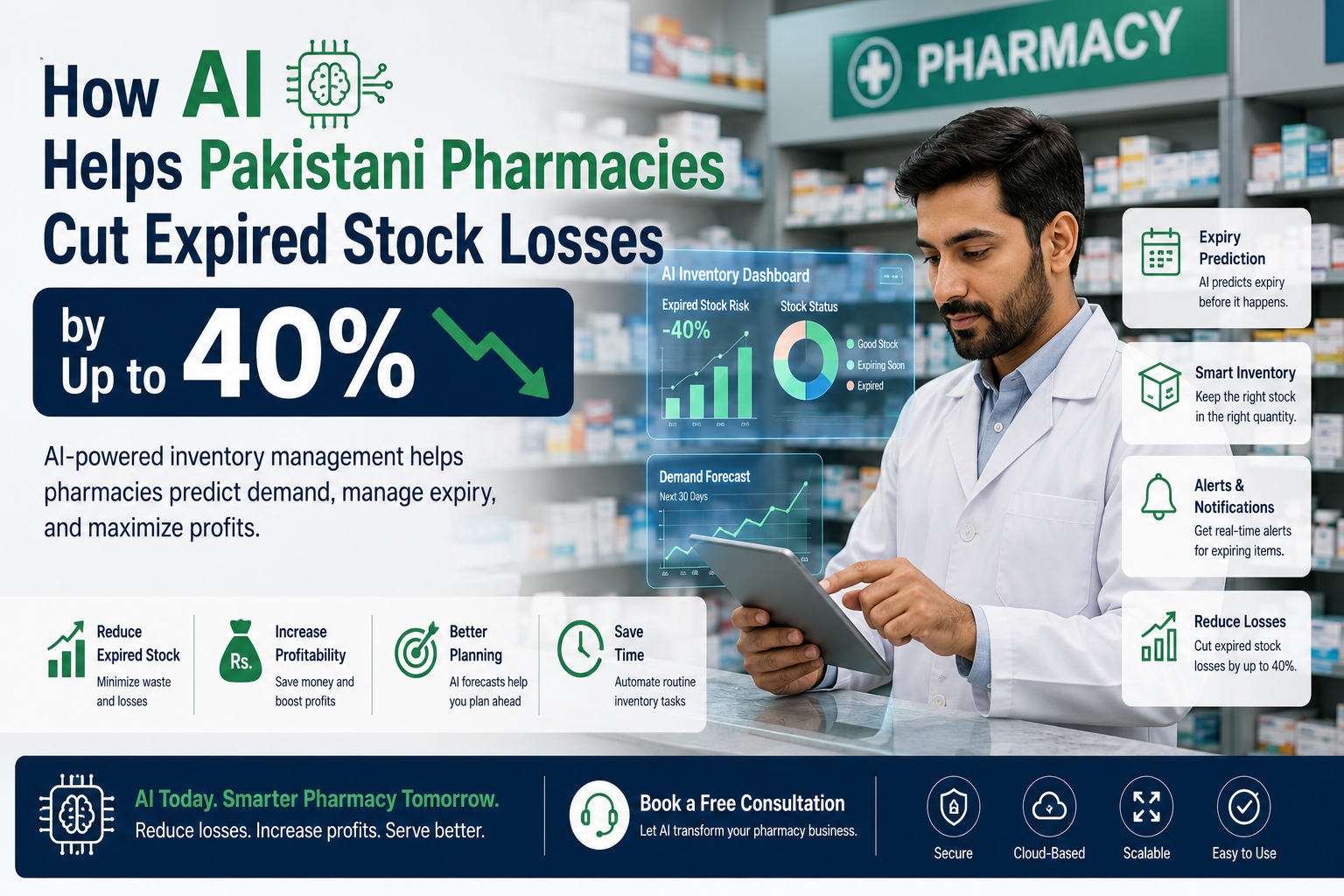
This is exactly where AI in pharmacy management changes the game. Modern pharmacy management systems in Pakistan now use artificial intelligence to forecast demand, rank batches by expiry risk, and tell owners what not to reorder. Pharmacies that adopt these tools commonly report cutting expired stock write-offs by 30–40% within the first year. Here's how it actually works.
The Hidden Cost of Expired Medicines in Pakistan
Unlike unsold clothing or electronics, medicines have a hard deadline. Once a strip crosses its expiry date, it isn't just worthless — disposing of it correctly costs time and care, since pharmaceutical waste must be handled separately from ordinary garbage. The World Health Organization has repeatedly flagged medicine wastage as a global issue across supply chains, and retail pharmacies sit at the very end of that chain.
For a mid-sized pharmacy stocking 3,000–5,000 SKUs, the maths is unforgiving:
- Purchase lock-in: Distributors often push bulk deals and seasonal schemes, so owners buy more than realistic demand.
- No batch visibility: Most stores know that they have Paracetamol, but not which batch expires next month versus next year.
- Slow-moving categories: Ointments, sprays, pediatric combinations and premium supplements are chronic expiry offenders.
- Price-sensitive customers: When a cheaper generic launches, branded stock can stall overnight — right there on your shelf.
Why Medical Stores Keep Overstocking Dead Inventory
If you visit wholesale markets like those around Saddar in Karachi or Abpara in Islamabad, you'll hear the same purchasing logic repeated: "Buy in bulk, get the discount, it'll sell eventually." Unfortunately, a 10% purchase discount means nothing when 25% of the consignment expires unsold.
Traditional medical store software doesn't solve this either. A basic billing POS records sales history but does nothing with it. It will happily let you reorder a slow-moving syrup at the same pace for two years, then print an expiry report after the loss is already locked in. The gap between "recording data" and "acting on data" is where Pakistani pharmacies bleed money — and where AI steps in.
How AI Predicts Expiry Risk Before It Happens
An AI-powered pharmacy management system treats every SKU as a small forecasting problem. Instead of waiting for expiry dates to arrive, it works backwards:
1. Demand Forecasting per Product
The system analyses 12–24 months of your own sales data — daily velocity, weekday patterns, seasonal spikes (flu season, allergy season, Ramzan, dengue season) — and projects how many units will realistically sell before each batch expires.
2. Expiry-Risk Scoring
Every batch gets a live risk score: "Batch B-4471 of Azithromycin 500mg: 84 units in stock, projected sell-through before expiry: 41%." High-risk batches are flagged months ahead, not days.
3. Smart Reorder Guards
When you're about to reorder a high-risk item, the system warns you before the purchase order is placed. This single checkpoint prevents most future write-offs, because dead stock always starts as an enthusiastic purchase.
4. FEFO Dispensing Automation
First-Expiry-First-Out is enforced automatically at billing — cashiers are routed to the nearest-expiry batch first, so old stock clears before new stock even opens.
5. Discount & Liquidation Suggestions
For batches approaching expiry with slow velocity, the system suggests practical exits: bundle offers, discount tags, or return-to-supplier windows that many distributors allow but pharmacies forget to use.
Key Features of an AI Pharmacy Management System
Beyond expiry control, modern pharmacy software in Pakistan bundles capabilities that used to require three separate tools:
- Batch-wise & expiry-wise inventory — every strip traceable to its lot number
- Auto reorder points based on real velocity plus supplier lead time, not guesswork
- Drug interaction & duplicate therapy alerts at the point of sale
- Controlled-drug registers maintained automatically for regulatory peace of mind
- Multi-branch dashboards so one owner sees stock health across all outlets
- Supplier scheme tracking — did that "buy 10 get 2" deal actually improve margins?
- WhatsApp order intake for regular customers and nearby clinics
Manual Registers vs Basic POS vs AI Pharmacy Software
| Capability | Manual Registers | Basic Billing POS | AI Pharmacy System |
|---|---|---|---|
| Sales recording | Handwritten, error-prone | ✅ Accurate | ✅ Accurate |
| Batch & expiry tracking | Rarely maintained | Limited / manual entry | ✅ Automatic per batch |
| Expiry warnings | After the fact (if ever) | Static date lists | ✅ Months-ahead risk scores |
| Demand forecasting | ❌ None | ❌ None | ✅ Seasonal + trend aware |
| Reorder protection | ❌ Owner memory | Simple min/max levels | ✅ Blocks high-risk reorders |
| Write-off reduction | — | Marginal | ✅ Typically 30–40% |
The pattern is clear: a basic POS digitises your paperwork, but an AI system actively protects your working capital.
A Real-World Example from Karachi
Consider a typical scenario we see across neighbourhood pharmacies in Karachi and Lahore: a store doing PKR 3–4 million in monthly purchases, holding inventory worth 45–60 days of sales. Before switching to an AI-driven system, the owner discovered — during a routine audit — nearly PKR 400,000 worth of stock expiring within 90 days, much of it purchased under distributor schemes that looked attractive on paper.
Within six months of running AI-assisted purchasing and FEFO dispensing, the same store's 90-day expiry exposure dropped below PKR 120,000, and monthly write-offs fell from roughly 4% of purchases to under 2%. Nothing about the customers changed — only the purchasing decisions became data-backed instead of habit-based.
Expiry Tracking and DRAP Compliance
Pakistan's Drug Regulatory Authority (DRAP) maintains strict requirements around storage, record-keeping, and recall handling for medicinal products. When a manufacturer issues a recall — which happens more often than most customers realise — pharmacies must identify affected batches quickly. Doing that from paper registers can take days; doing it from a batch-indexed database takes seconds.
A proper system also keeps digital purchase and sale trails per batch, which inspectors increasingly expect during licensing visits and audits. For chain pharmacies, centralised reporting makes multi-branch compliance a weekly report instead of a monthly crisis.
What Does AI Pharmacy Software Cost in Pakistan?
Pricing varies with scale, but realistic 2026 market ranges look like this:
- Single-counter medical stores: PKR 3,000–8,000/month cloud subscription, or PKR 80,000–150,000 one-time licence
- Multi-counter + warehouse setups: PKR 15,000–35,000/month depending on terminals and branches
- Custom-built systems (your exact workflow, integrations with distributors' portals, WhatsApp ordering): typically PKR 250,000–600,000 development with annual support
Frame any quote against your current write-offs: if expired stock costs you PKR 50,000 a month and the system eliminates even half of it, the software pays for itself several times over — everything else (billing speed, theft visibility, customer loyalty) is bonus ROI.
Frequently Asked Questions
How accurate is AI demand forecasting for medicines?
For established products with steady usage, quality systems typically land within 10–15% of actual demand. Accuracy improves continuously because every day of new sales data refines the model. New products start conservatively until enough local history builds up.
Will it work for a small single-shop medical store?
Yes — smaller stores arguably benefit most, because a single bad bulk purchase hurts them proportionally harder. Cloud-based systems need only a standard computer or tablet and work fine on regular broadband.
Can the system handle Urdu product names and local pack sizes?
A locally developed web application built in Pakistan handles Urdu labelling, local pack conventions (strips, vials, sachets), and distributor-specific SKUs far better than generic imported software.
What happens to my existing sales data if I switch systems?
Established providers migrate historical data — item masters, stock balances, and ideally 12+ months of sales history — so the AI starts with context rather than learning from zero. Always confirm migration support before signing.
Does the software stop my staff from selling expired medicine?
Yes, through hard blocking. When a batch crosses its expiry date, the point of sale refuses to bill it and flags the batch for disposal documentation — protecting both patients and your licence.
Is my pharmacy data safe on a cloud system?
Reputable systems encrypt data in transit and at rest, run daily backups, and give you export rights. Ask any vendor directly about backup frequency, hosting location, and what happens to your data if you cancel.
How long does implementation take?
A single-location store typically goes live within 1–2 weeks including data migration and staff training. Multi-branch rollouts take 3–6 weeks depending on how quickly stock counts are verified.
