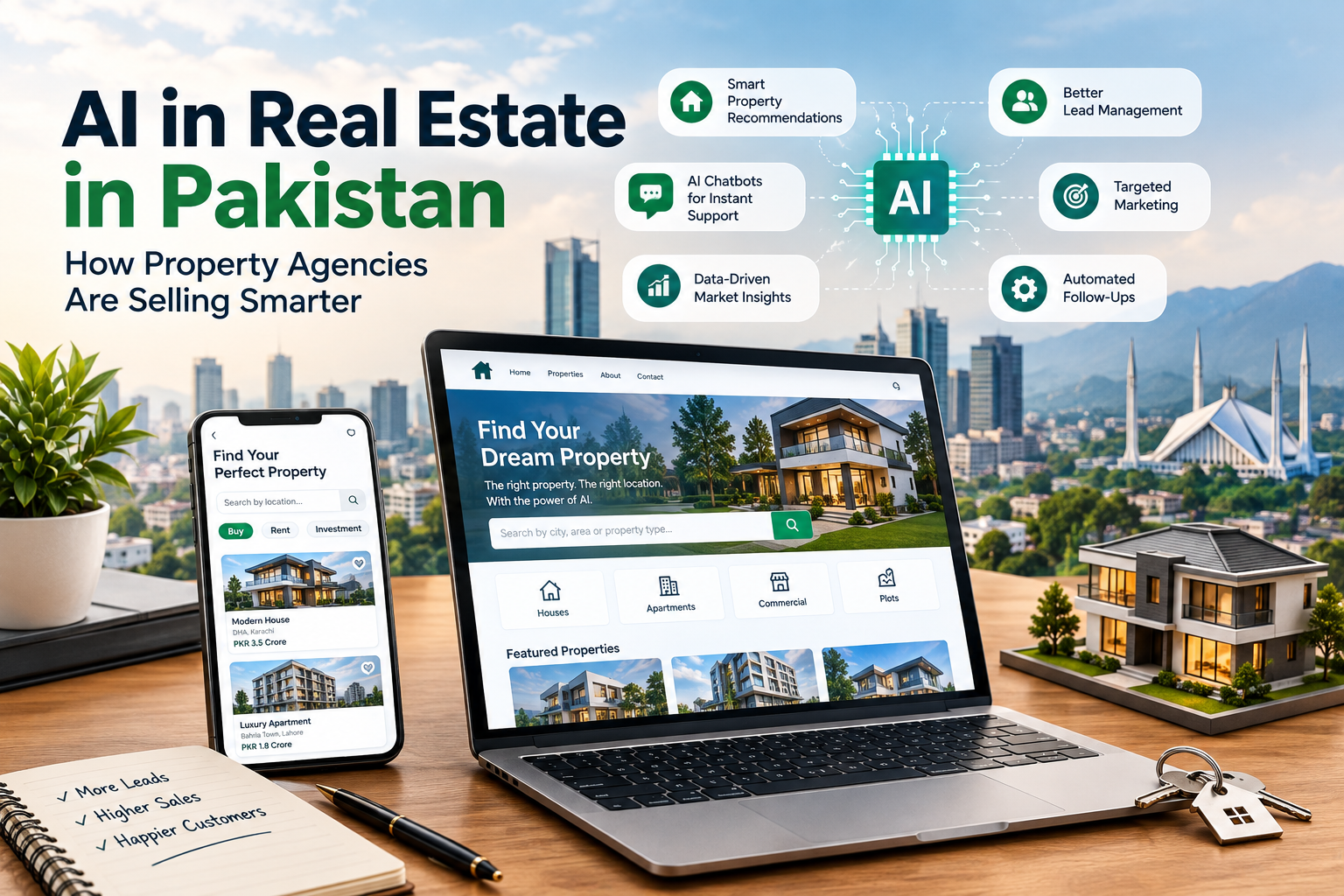
1. Why Real Estate Was Ripe for AI
Real estate is the world's largest asset class and one of its least digitised industries. In Pakistan, a property is often still bought after weeks of driving between societies, haggling on hearsay prices and trusting a broker's word on paper documents. The industry runs on manual listings, gut-feel pricing and phone-book lead tracking.
AI changes exactly these three things. It prices property from data instead of guesswork, matches buyers to properties in seconds instead of weeks, and turns every enquiry into a tracked, scored lead. Globally the shift is already documented — firms like McKinsey track how data and AI are reshaping property valuation and asset management, while the Stanford AI Index ranks real estate among the fastest-growing sectors for AI adoption.
Pakistan's timing is good. Property portals like Zameen.com have already trained buyers to search online. The agencies and developers who add an AI layer to that habit — instead of just posting listings — will be the ones closing deals in the next five years.
2. The Pakistani Property Industry's Pain Points
- Pricing is guesswork. Two sellers in the same society quote different rates for identical plots, and nobody can prove which is right. There is no standardised valuation data for most Pakistani cities.
- Lead tracking happens on paper and WhatsApp. Agents juggle dozens of enquiries, forget follow-ups, and have no idea which leads deserve the fastest call.
- Dead listings dominate portals. Properties stay online after they are sold, wasting buyer time and agency credibility — and fake listings poison trust in whole societies.
- Buyers ask the same questions 100 times. "Is the file transferred? What is the exact location? Are utilities connected?" — every answer costs an agent's paid minute.
- Documents are verified manually. Title checks and ownership verification run on phone calls and physical visits, slowing every deal.
- Marketing is spray-and-pray. Agencies boost posts to broad audiences instead of the small group of buyers actually looking in a given society and budget.
Every one of these is a machine-learning problem. AI does not replace the agent's negotiation skill — it removes the manual drag that costs agencies their margins.
3. 7 AI Use Cases Reshaping Property Sales
🏠 1. Automated Property Valuation & Price Prediction
AI models trained on sold-price records — society, size, floor, age, distance to amenities, development activity — produce a defensible market value for any property in seconds. Sellers stop overpricing and waiting a year; buyers stop haggling blind. For developers, the same model forecasts off-plan price movement in areas like DHA, Bahria and Gulberg, guiding launch pricing decisions that currently depend on instinct.
🔍 2. Smart Property Search & Recommendations
Instead of scrolling through thousands of listings, buyers describe what they want and the system ranks matches — exact area, budget, orientation, floor preference, even "close to Metro" or "near a good school." It learns from viewed listings and shortlists, so an old villa buyer stops being shown new apartments. This is the same recommendation logic that made ecommerce giants successful — we covered how it works in AI in ecommerce for Pakistani stores, and the mechanics transfer directly to property portals.
🤖 3. WhatsApp Chatbots for Property Enquiries
Pakistani buyers enquire over WhatsApp, not forms. An AI chatbot answers property questions 24/7 — price, photos, location details, visit slots — in Urdu, Roman Urdu and English, and books viewings into the agent's calendar. It captures the enquiry before the buyer moves to the next society's page. (For the broader playbook, see our WhatsApp AI chatbot guide.)
🎯 4. AI Lead Scoring & CRM Automation
Every enquiry gets a score: is this buyer pre-qualified? How hot is the budget match? Which properties have they shortlisted? The system routes hot leads to the top agent instantly and sequences follow-ups automatically — no more "sorry, I forgot to call back." A CRM solution built for this workflow turns WhatsApp conversations into a visible pipeline instead of a lost chat thread.
🖼️ 5. Virtual Tours & AI-Generated Visuals
AI stitches 360° virtual tours from a phone walk-through, removes clutter from photos, and generates furnished renders of empty rooms. Pakistani buyers — many living abroad in the Gulf and UK — can inspect a flat in Karachi from Dubai at midnight. Overseas buyers are the highest-margin segment for Pakistani real estate, and virtual viewing removes the single biggest barrier to their purchase.
📄 6. Document Verification & Fraud Detection
Title transfer files, CNIC ownership records and society documents carry the highest risk in Pakistani property deals. AI reads and cross-checks the paperwork — flagging mismatched names, expired documents, duplicate submissions and suspicious patterns — before money moves. Agencies using it close deals faster and never get caught in a scam transaction, a reputation killer in this market.
📣 7. Predictive Marketing & Lookalike Audiences
Machine learning finds the small audience actually buying in a society — based on previous enquiries, budget clusters and behaviour — and targets ads there instead of spraying a city-wide feed. Combined with professional digital marketing services in Karachi, agencies cut their cost per qualified enquiry sharply.
💡 Priority order: most agencies should start with chatbot + lead scoring + price prediction — the three with the fastest payback — then layer virtual tours and document verification. Portals and developers benefit most from recommendations and predictive pricing first.
4. Traditional Agency vs. AI-Powered Agency
| Activity | Traditional Agency | AI-Powered Agency |
|---|---|---|
| Property valuation | Owner's asking price, gut feel | Data-backed price range per society |
| Buyer matching | Manual scrolling of listings | Automated ranked shortlists |
| Enquiry response | Office hours, one agent | 24/7 chatbot, instant reply |
| Lead handling | Paper & WhatsApp jumbles | Scored pipeline in a CRM |
| Viewing | Physical visits only | 360° virtual tours first |
| Document checks | Phone calls & visits | Automated cross-checks |
| Marketing | Broad boosted posts | Lookalike targeting from real buyers |
5. How Agencies Can Start Small
- Clean up lead capture first. Every enquiry — WhatsApp, calls, walk-ins — goes into one pipeline. If your agency's CRM is two phone books, this is the moment to adopt a real CRM rather than bolt AI onto chaos.
- Automate the first conversation. Put a chatbot on your WhatsApp Business number to answer pricing/location/visit questions and capture the enquiry. This is a one-week win.
- Score your leads. Let the system rank enquiries by budget-fit and activity so your best agents call the right people first.
- Add data tools. Bring in price prediction for your core societies, then virtual tours for your premium listings. Measure response time, viewing rate and closure rate every 60–90 days and expand.
Need the foundation built? Global Dezigns provides real estate website design and portal development in Pakistan — listing management, advanced search, agent panels — and can integrate the AI layers on top. We also build custom software when an agency's workflow needs something unique.
6. What ROI Looks Like
- Faster response: agencies answering enquiries within 5 minutes close substantially more deals than those answering in hours — a chatbot makes 5-minute response automatic, 24/7.
- Lead hygiene: scored, tracked pipelines typically recover 20–30% of leads that previously went cold from forgotten follow-ups.
- Overseas buyers: virtual tours open the Gulf/UK buyer segment, where per-deal commissions are typically multiples of local deals.
- Ad efficiency: lookalike targeting lowers cost per qualified enquiry while raising conversion.
- Risk reduction: automated document checks prevent one fraudulent transaction that could cost an agency its reputation and six figures in rupees.
Independent research — from McKinsey's real estate practice to the Stanford AI Index — consistently shows first movers capturing disproportionate share in property markets undergoing digitisation. Pakistani real estate is at exactly that inflection point.
7. Frequently Asked Questions
Q1: Is AI in real estate affordable for a small agency in Pakistan?
Yes. Chatbots, lead scoring and valuation tools run as services with monthly pricing, and integration onto existing WhatsApp and CRM workflows is quick. A single saved deal from better follow-up usually covers a year of the technology.
Q2: Will AI replace real estate agents?
No — it removes manual work so agents do what they are paid for: negotiating, relationships and closing. Agencies that adopt AI simply outwork those that do not; the agent's role shifts from paper-chasing to advising.
Q3: Can AI understand Urdu and Roman Urdu property enquiries?
Yes. Modern language models handle Urdu, Roman Urdu and code-mixed messages naturally, including society names. Our Urdu AI guide covers where local-language AI works best in Pakistan.
Q4: Does price prediction work for Pakistani cities with thin data?
It works best where sales records exist — established societies in Karachi, Lahore and Islamabad. For new societies, models rely on comparable areas and development milestones. Accuracy improves as your own agency data accumulates, which is a reason to start collecting it now.
Q5: Do I need a new website to use AI?
Not always — chatbot and CRM layers integrate with most existing setups. But portals and agencies on static sites with no data export will hit a wall; that is when rebuilding on a proper real estate website platform pays for itself.
Q6: How quickly will we see results?
Response-time and lead-hygiene wins show in the first month. Valuation and recommendations sharpen over 2–3 months of data. Most agencies see measurable gains in enquiry-to-viewing conversion inside one quarter.
8. Conclusion
Pakistani real estate has been one of the last industries to digitise — and that is exactly why the opportunity is large. Buyers already search on portals; the agencies, developers and portals that add the AI layer — smart pricing, instant WhatsApp responses, scored lead pipelines, virtual tours and automated document checks — will capture the deals while slower competitors still drive between societies. AI in real estate does not replace the industry's human element; it removes everything that slows it down.
View All Blogs