1. Why Customer Support Breaks Before the Software Does
A customer asks about an order, a service appointment, a return or a billing issue. The request arrives through a phone call, WhatsApp, email, a website form or a walk-in — and each channel becomes a separate note in a staff member’s notebook. When the team cannot see the full history, the customer repeats the same question and the business loses time on work that should have been reusable.
For many Pakistani SMEs, the first support problem is not a lack of technology. It is the absence of a shared workflow. A proper customer service system gives every enquiry a ticket, an owner, a priority, a status and a clear next action. That foundation matters before an AI layer is added.
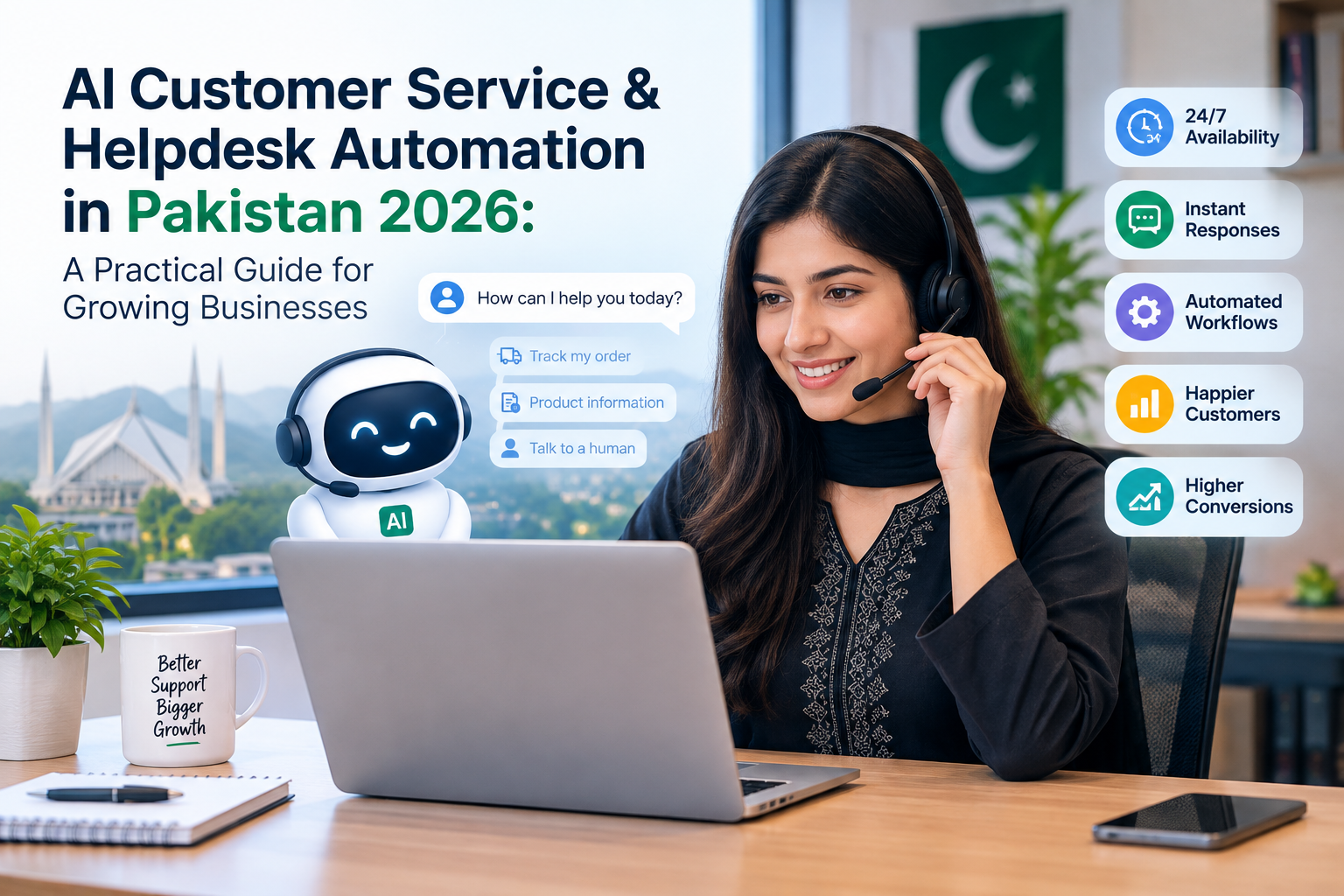
AI customer service is useful only when it can work with that workflow. It can identify the intent of a request, retrieve a relevant answer from an approved knowledge source, suggest the next step to a human agent and create a clean summary of the conversation. It should reduce administration, not create a new layer of confusion.
2. What AI Customer Service Actually Does
Think of AI customer service as an assistant across the support lifecycle rather than a chatbot on a website. The same capability can help a customer self-serve, organise the queue, assist a human teammate and reveal patterns in the questions the business receives every week.
Useful functions include:
- Intent detection: recognises whether a message is about a delivery, refund, appointment, technical fault, complaint or general information.
- Intelligent routing: sends the ticket to the right department, skill group or priority queue instead of relying on a staff member to sort everything manually.
- Self-service: answers approved questions and guides customers to the right knowledge article or request form.
- Agent assistance: summarises the conversation, retrieves relevant policies and drafts a response for human approval.
- Follow-up automation: sends status updates, requests missing information, schedules callbacks and asks for feedback after a resolved ticket.
- Trend detection: groups recurring questions so the business can improve its website, catalogue, delivery promise or staff training.
3. Practical AI Helpdesk Use Cases for Pakistani Businesses
The best starting point is a repetitive process with a clear answer and a low-risk action. These examples work across industries:
Online sellers: classify order-status questions, collect an order number, link the ticket to the order record and route a delivery exception to the responsible team. A delivery system can provide the status, but the helpdesk should own the customer conversation.
Clinics and service businesses: collect appointment preferences, explain opening information, confirm requested details and flag urgent requests for a person. The system should not make clinical decisions or promise an appointment that has not been confirmed.
Property agencies: organise enquiries by property, area, budget and viewing request, then assign each lead to the right agent. This is a broader helpdesk workflow than simply putting a WhatsApp auto-reply in front of a visitor.
Education and training providers: answer published course FAQs, collect fee or admission questions and route sensitive student or parent issues to authorised staff. A robust custom software foundation keeps the workflow consistent.
Property, construction and field-service teams: track a complaint from first contact through inspection, repair, completion and customer confirmation. The ticket becomes a service record rather than a forgotten message.
4. AI Helpdesk Automation Is Not the Same as a WhatsApp Chatbot
A WhatsApp chatbot is a channel-specific tool. It can answer a customer on WhatsApp, collect a phone number and trigger a simple flow. An AI helpdesk is the operational layer that can receive requests from WhatsApp, web forms, email, phone notes, social channels and walk-ins, then place them into one managed queue.
For Global Dezigns, the important distinction is this: a chatbot can be the front door, while the helpdesk owns the ticket, customer record, history, assignment, escalation and resolution. A business that only launches a WhatsApp bot without a clean backend may improve its first reply but still lose the customer after the conversation.
Our WhatsApp AI chatbot guide covers the messaging layer in detail. This article focuses on the wider customer service system that connects that channel to the business.
5. The Building Blocks of a Useful AI Customer Service System
A reliable implementation is built in layers. Buying a “smart” tool before the foundations are ready usually creates a polished demo and a frustrating daily workflow.
1. Shared ticket and customer record. Every request receives an ID, a channel, a history and an owner.
2. Knowledge base. Approved answers, service policies, delivery conditions and troubleshooting steps should be written for customers, not only for internal staff.
3. CRM or business-system integration. Order status, appointment data, account information and inventory status should be retrieved from the system that owns the data.
4. Routing and escalation rules. Define which requests need a human, which team owns them and what information must be collected first.
5. AI layer. Add intent detection, summaries, suggestions and self-service only after the data and workflow are dependable.
6. Reporting and quality review. Track first response time, resolution time, backlog, escalation rate, reopen rate and customer feedback. The goal is fewer repeated questions, not simply more messages sent automatically.
6. Manual Support, Rules-Based Automation and AI: Which One Fits?
Not every business needs an autonomous AI agent. Choose the simplest approach that solves the actual problem and leaves a human in control when the request is sensitive or unusual.
The table below is a practical starting point, not a promise of results.
| Approach | Best for | Strength | Limit |
|---|---|---|---|
| Manual support | Small teams and early process design | Human judgement and flexibility | Inconsistent tracking and slower repetitive work |
| Rules-based automation | Known, repeatable requests | Predictable routing and messages | Breaks when wording or context changes |
| AI-assisted support | Growing ticket volumes and mixed questions | Summaries, intent detection and helpful suggestions | Needs approved knowledge and human review |
| AI agent with escalation | High-volume, well-defined workflows | Can handle routine requests and execute approved actions | Not suitable for every sensitive or unusual case |
7. A 90-Day Implementation Roadmap for a Pakistani SME
A controlled pilot is safer than switching every channel at once. Use the following sequence as a starting point and adjust it to the size of your team and the complexity of your business.
Days 1–15: map the work. List the top recurring questions, the channels customers use, the information each answer needs and the cases that must always reach a person.
Days 16–30: build the queue. Set up tickets, priorities, assignment rules and a basic customer record. Ask staff to use the new process for every request, even the small ones.
Days 31–60: add knowledge and automation. Publish approved answers, create self-service forms, automate status checks and summaries, and route requests by intent and priority.
Days 61–90: test and improve. Compare response and resolution metrics with the manual baseline, review errors, tighten escalation rules and only then expand the scope. A Global Dezigns software team can scope a custom workflow when off-the-shelf tools cannot match your process.
8. Frequently Asked Questions
Q1. Is AI customer service affordable for a small business in Pakistan?
There is no single price. Cost depends on the channels, the number of agents, integrations, data migration, language needs and whether you use a standard tool or a custom workflow. A small business can begin with a focused helpdesk and approved FAQ knowledge base, then add AI features after the process is stable. Ask for a scope that includes setup, training, maintenance and data handling rather than comparing the headline subscription price alone.
Q2. Will AI replace customer support staff?
AI is better suited to repetitive intake, routing, self-service, summaries and routine follow-ups. Complex complaints, sensitive customer situations and decisions requiring business judgement should remain with trained people. The practical goal is to give support staff better context and more time for the work that needs empathy and judgement.
Q3. Can the helpdesk work with WhatsApp, email and a website form?
Yes, if the chosen platform or custom system supports the relevant channels and can store messages in one customer timeline. A WhatsApp bot can feed tickets into the same queue as email and web enquiries, but channel integration, notifications, privacy and staff permissions should be tested before launch.
Q4. What information should we prepare before implementing AI?
Start with common questions, service policies, escalation rules, customer categories, expected response times and examples of requests that require a person. Old support chats, email threads and call notes can help identify patterns, but personal information should be reviewed and handled under an appropriate data policy.
Q5. How do we know whether the automation is working?
Track first response time, time to resolution, backlog, self-service rate, escalation rate, reopen rate and customer feedback. Compare the new workflow with the previous manual baseline. Accuracy and customer outcomes matter more than the number of automated messages sent.
Q6. Can we start without replacing our CRM or website?
Often, yes. A standard helpdesk can start with a small pilot and limited integrations. If the existing system cannot export customer, order or appointment data reliably, a custom integration or a foundation rebuild may be more suitable than forcing an automation layer onto inaccessible data. Global Dezigns can assess that with you.
Q7. How is this different from the WhatsApp AI chatbot guide?
The chatbot article focuses on a WhatsApp-first conversation experience. This guide covers a cross-channel helpdesk: tickets, customer history, routing, knowledge, agent assistance, escalation and reporting. WhatsApp can be one channel inside that wider system.
9. Conclusion: Build the Workflow Before Automating the Answer
AI customer service works best when a business already knows how it wants to serve customers. A shared ticket queue, reliable knowledge and clear escalation rules give AI the context it needs. Without those foundations, automation only makes an inconsistent process run faster.
Start with one channel and one measurable workflow. Prove that customers receive accurate information, staff spend less time repeating the same explanations and the team can always identify a human when judgement is required. Then expand one step at a time.
Important: AI should reduce repetitive handling while keeping ownership clear. A customer should know when a human is being involved, and sensitive requests should follow an approved escalation path.
