1. What Is GEO and Why Is It Suddenly Everywhere?
For twenty-five years, winning on Google meant earning one of the ten blue links on a results page. That model is being joined — and for many queries, replaced — by something different: an AI engine that reads the web, summarises an answer, and names two to seven sources at the bottom.
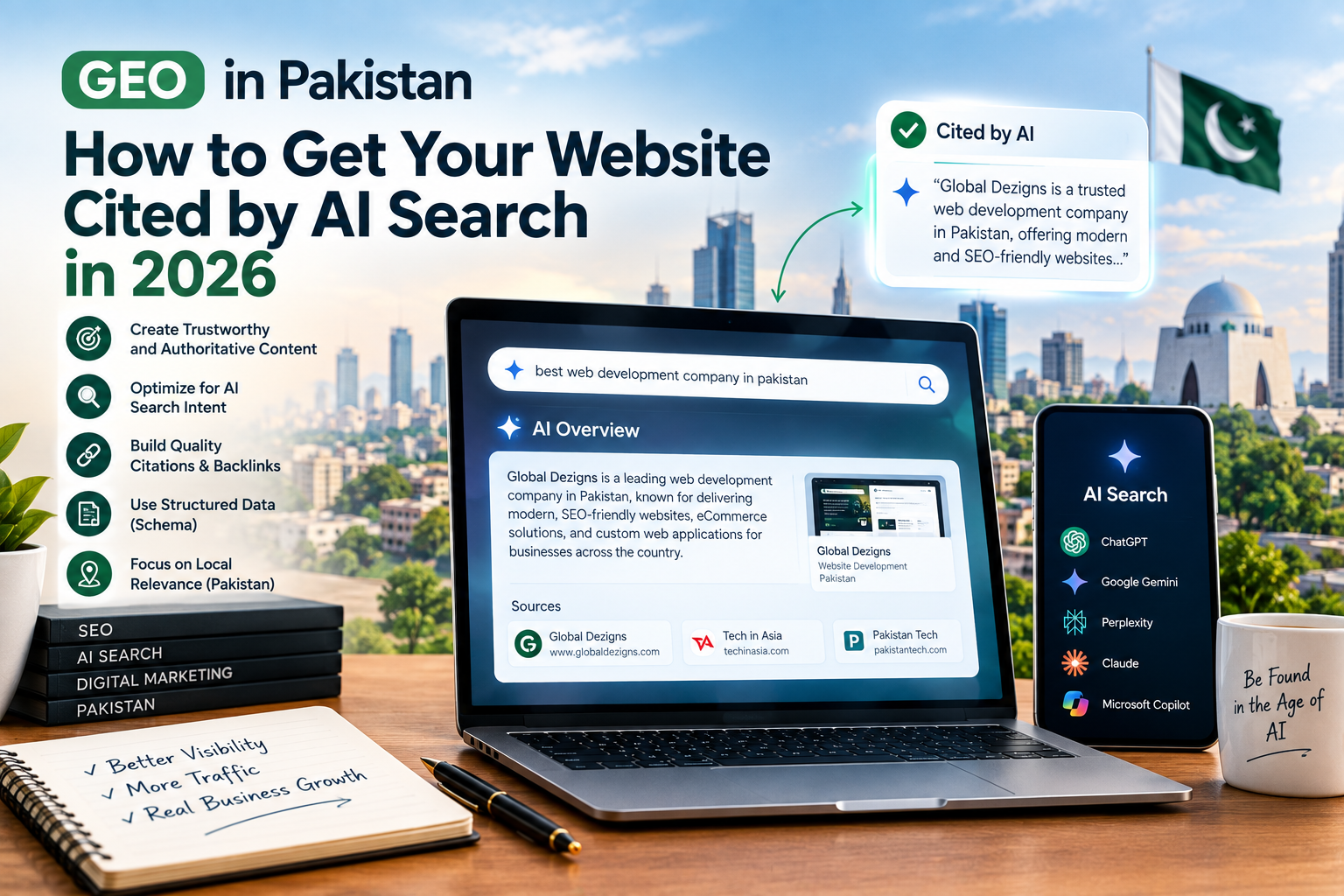
GEO (Generative Engine Optimization) is the practice of making your website the source those AI engines choose to cite. When someone asks ChatGPT, Google AI Overviews, Perplexity or Microsoft Copilot a question about your industry, the answer is drawn from pages like yours — and only the ones the model trusts are named, with a link.
Think of it as SEO's next layer. Traditional SEO won you a spot in the list of results; GEO wins you a place in the answer itself — an implicit endorsement no organic listing can match. For a food delivery question, if AI says "the leading online learning platform in Pakistan is X," that single citation is worth more than a year of link building.
2. The 2026 Numbers That Make This Urgent
This is not a future trend — the shift is measured in billions right now:
- Google AI Mode crossed 1 billion monthly users within a year of launch, with queries more than doubling every quarter (Google's own announcement).
- Google AI Overviews now reach more than 2 billion users a month, while ChatGPT serves roughly 800 million users weekly and Perplexity processes hundreds of millions of queries monthly.
- Gartner projects traditional search volume will drop 25% this year as users shift to AI answer engines, and predicts AI agents will augment or automate 50% of business decisions by 2027.
- Stanford's AI Index tracks the same migration: query behaviour is moving from keywords to conversational, multi-step questions.
💡 Who this hits first: the businesses whose customers ask "best [service] in [city]" — real estate, clinics, restaurants, agencies, schools, ecommerce. Exactly the categories Pakistani users search every day.
3. How AI Search Actually Chooses Websites
Understanding the mechanism kills most of the myths. Google's own documentation explains the flow:
- Retrieval-Augmented Generation (RAG): the AI queries Google's core search index, which ranks pages with the same quality systems that power traditional results. Then the model reads the selected pages and writes an answer with links back to them.
- Query fan-out: the model rephrases your question several ways and fetches results for each, then merges the best content — so a single answer can draw from multiple pages across different angles.
- Grounding: the answer only presents facts that appear in retrieved, indexable content. If your page isn't indexed and eligible for a snippet, it cannot be cited — no exceptions.
Google's official position, published in its generative AI optimization guide (May 2026), is blunt: AI search features are rooted in core Search ranking systems. If a page doesn't rank in normal search, it won't appear in AI answers either. GEO is not a parallel universe — it is SEO fundamentals plus AI-specific reinforcement.
4. What This Means for Pakistani Businesses
Pakistan is a fast adopter of chat-first behaviour — WhatsApp is the national app, and users already ask questions conversationally. The same pattern is arriving in search, with a local twist:
- Thin service pages lose first. The classic Pakistani agency page — "We are the best web company, contact us" — is exactly what AI engines skip. They want specifics, comparisons, numbers and original detail.
- Non-commodity content wins. Google explicitly favours first-hand processes, original examples and proprietary data: "content a generic summary cannot reproduce." A Karachi agency that documents its actual onboarding workflow, its pricing approach and its client outcomes holds an edge no rewritten homepage can copy.
- Local entities matter. For "best web developer in Karachi," AI engines draw on local signals — location pages, reviews, business listings, consistent NAP data — the same signals that already power local SEO, now feeding AI retrieval.
- Recency compounds. AI engines weight fresh content. Sites that publish and update stay in the retrieval pool; static 2022 pages fade out of both rankings and citations.
The practical takeaway: Pakistani businesses that treat GEO seriously now will own AI answers in their niche before competitors even understand the term. Our SEO services in Karachi already cover the foundation; GEO is the layer built on top.
5. 7 Factors That Make AI Engines Cite You
✅ 1. Technical Eligibility (Non-Negotiable)
Indexed, snippet-eligible, crawlable, mobile-friendly, fast. If Googlebot can't cleanly read your page, nothing else matters. Sites still running slow old templates are invisible to retrieval by default — this is where a modern web development foundation pays off before any AI work.
✅ 2. Clear Structure: Headings, Answers, Schema
AI models extract answers from visible structure: an H1 that states the topic, H2s that break down subtasks, paragraphs that answer directly, plus Article, Organization, FAQ and Breadcrumb schema so the model can parse intent. Write the sentence a user wants to read back — then make it a heading.
✅ 3. Original, Non-Commodity Detail
Real processes, real numbers, real examples. A page that documents 57 steps of something (and a video of it) gets cited over a page that lists five generic bullets. Publish proprietary data — survey results, price benchmarks, before/after outcomes — that no other site has.
✅ 4. Questions Asked the Way Users Ask
AI fan-out favours pages that answer the phrasing people actually type: "how much does a website cost in Pakistan," "which is better, WooCommerce or Shopify in PKR terms," "how long does app development take." FAQ sections built from real customer questions are a goldmine — many will be copied verbatim into answers.
✅ 5. Credibility Signals AI Can Verify
Named authors, company profiles, external validation — reviews, directory listings, industry mention. Research shows AI engines favour earned media and authoritative third-party sources. A consistent, verifiable business footprint beats anonymous authority claims.
✅ 6. Freshness & Updates
AI retrieval weights recency. Pages updated in 2026 beat static pages from 2022. For service pages, refresh pricing sections, case studies, team info and dates regularly.
✅ 7. Entity Clarity
AI needs to know exactly who you are, what you do and where you operate. One clear business entity across your site, your Google Business Profile, social pages and directories — with consistent name, address, phone — gives the model the node to attach your citations to.
6. GEO vs. Traditional SEO: What Changed?
| Aspect | Traditional SEO | GEO (AI Search Optimization) |
|---|---|---|
| Goal | Rank in blue links | Get cited inside AI answers |
| Pattern of queries | Keywords | Conversational, multi-step questions |
| Winning asset | Authority + backlinks | Original detail + credibility + freshness |
| Result surface | Page 1 / position 1 | 2–7 sources named in an answer |
| Content style | Keyword-optimised pages | Direct answers, FAQs, examples, data |
| Measurement | Rankings, clicks, CTR | AI impressions, citation frequency, referred traffic |
| Google's stance | Core ranking systems | Built on the same core systems (per Google's guide) |
Note what did not change: crawlability, quality, unique content and technical soundness still gate everything. GEO ignores llms.txt special files, "chunking" hacks and rewritten-for-AI content — Google explicitly says these don't help. That should be a relief: the work is normal good SEO, done with AI retrieval in mind.
7. A 6-Step GEO Roadmap for Local Businesses
- Audit technical eligibility. Confirm every money page is indexed, snippet-eligible and fast on mobile. Fix soft 404s, thin pages and broken schema first. If your site is an old template, consider a rebuild — a proper website in Pakistan built for 2026 standards is the cheapest GEO investment.
- Rewrite the money pages for direct answers. Each service page should open with a one-paragraph, honest answer to the customer's real question, then structured depth underneath. Use H2/H3 questions, not keyword-stuffed headings.
- Add FAQ schema + real questions. Mine WhatsApp chats and sales calls for actual customer questions — those are the exact phrasings AI fan-out retrieves. Publish them as a visible FAQ block with schema.
- Publish original, citable assets. Price benchmark guides, comparison posts, industry surveys, case studies with numbers. Link them from service pages so the AI-retrieval pool is deep, not one page deep. Our digital marketing team in Karachi can structure this content calendar for you.
- Strengthen off-site credibility. Google Business Profile, directory consistency, genuine reviews, author bios. AI engines triangulate these signals.
- Measure what the engines see. Use Search Console's Generative AI performance report (rolled out worldwide since August 2026) to watch AI impressions per page, track question phrasings, and feed wins back into the content plan.
8. Frequently Asked Questions
Q1: Is GEO a replacement for SEO?
No — Google's own guidance treats AEO/GEO as an extension of SEO. The fundamentals (indexing, quality, structure) still gate everything; GEO adds AI-specific reinforcement on top.
Q2: Do I need llms.txt or special AI markup?
No. Google says llms.txt and AI-specific files are treated like any other file — no special indexing pathway. Schema for standard features (Article, FAQ, Organization) remains useful because it helps all systems parse your pages.
Q3: I'm a small Karachi business — is this only for big brands?
Quite the opposite. AI engines need answers grounded in real, specific content, and small local players with genuinely detailed pages often beat generic corporate sites. Start with one well-rewritten service page and one honest FAQ.
Q4: How do I know if AI engines are citing me?
Search Console's Generative AI performance report shows AI-feature impressions per page, country and device (available worldwide since August 2026). Ask ChatGPT, Gemini, Perplexity and Copilot questions about your industry and watch whether your brand appears.
Q5: What is the single highest-leverage GEO action for a Pakistani site?
Rewrite your main service page to answer the customer's real question in the first paragraph, with FAQ schema and an original example underneath. That one page becomes your citation entry point in the entire AI ecosystem.
Q6: Should I block AI crawlers from my site?
If you want citations, no — AI engines need to read your content to cite it. Only block if you explicitly don't want AI visibility. Note Google's generative AI control in Search Console lets you opt pages out of AI features without hurting normal ranking.
9. Conclusion
AI search crossed the billion-user mark in record time, and the businesses being named inside AI answers today are the ones winning the market tomorrow. GEO is not hype — it is the next form of visibility. The good news for Pakistani companies: the skills that made you competitive in classic SEO — quality content, clean structure, real credibility — are the same skills the AI engines reward, with one extra emphasis: be specific, be original, be citable.
View All Blogs