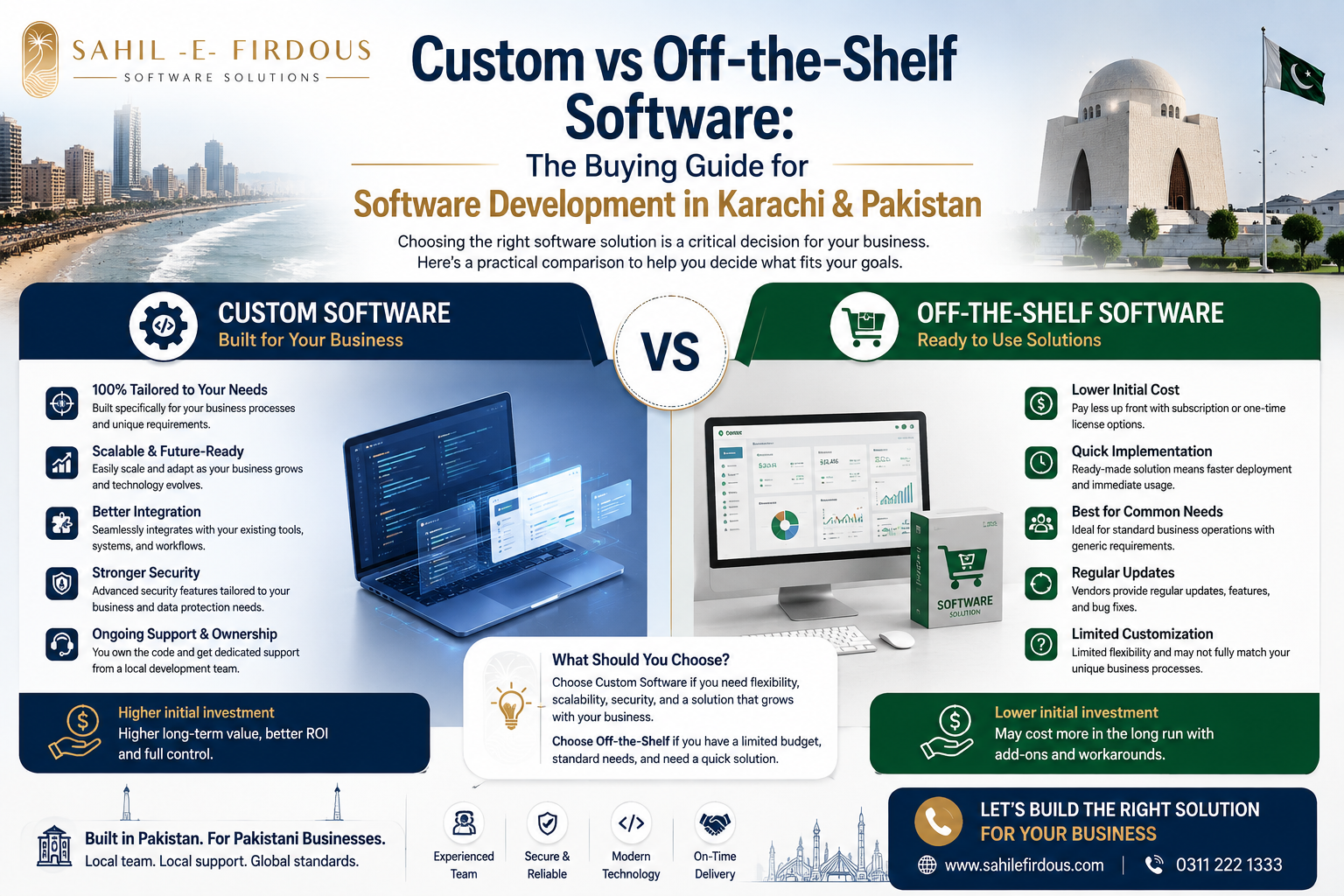
1. The Decision Every Business Faces
Every business in Karachi or Lahore eventually hits the same wall: the spreadsheet has become unmanageable, the old accounting package no longer matches how the company actually works, and the team is wasting hours on data entry. At that moment, the owner opens Google and searches for software development in Pakistan — then immediately faces a second decision: buy a ready-made product, or commission custom software development in Karachi?
Both roads work. Both roads can also drain your budget quietly. This guide exists to make that choice honestly — what each option really costs over three to five years, where they break, and how to decide in your own context. It is written by a Karachi software company that has built systems for retailers, schools, pharmacies, couriers and exporters — and has also rescued businesses from software that was "cheaper" at purchase and far more expensive in reality.
2. What "Off-the-Shelf" Software Really Means
Off-the-shelf (also called commercial off-the-shelf, COTS) software is a product built for a general market, sold to many customers with the same core features. Examples a Pakistani business will recognise immediately:
- Generic accounting packages that come with standard chart-of-accounts templates.
- Ready-made POS systems sold per terminal.
- Standard school management or clinic management products with fixed modules.
- Subscription CRMs that manage leads the way the vendor decided leads should be managed.
The appeal is obvious: there is a demo, the price is known, and it can go live within days. For standard, well-defined processes, that is genuinely valuable.
3. What Custom Software Development in Pakistan Means
Custom software is built around your business processes — your invoicing rules, your Urdu product names, your delivery routes, your exam formula, your commission structure. A software development company in Karachi or elsewhere in Pakistan analyses how your team actually works, then designs a system that matches it, instead of forcing your team to match the software.
Custom does not mean "from absolute zero" — modern development reuses proven frameworks, security libraries and integrations. It means the final product is owned by you, shaped for you, and licensed to nobody else.
💡 Quick mental model: off-the-shelf is renting a furnished flat — move in fast, but you live in someone else's layout. Custom is building your own house — slower to start, but every room fits your life.
4. Honest Side-by-Side Comparison
| Factor | Off-the-Shelf | Custom (Bespoke) |
|---|---|---|
| Time to launch | Days to weeks | Weeks to months |
| Upfront price | Low, predictable | Higher, quoted after analysis |
| Fit to your process | You adapt to the software | Software adapts to you |
| Licensing | Subscription or per-seat, recurring | You own it (no recurring license) |
| Customisation | Limited to what vendor offers | Unlimited — your requirements rule |
| Integrations | Only supported connectors | Anything: XML, APIs, WhatsApp, USSD |
| Data ownership | Often stored with vendor | Yours, on your server |
| Vendor lock-in | High — switching means migrating | Low — you hold code and data |
| Long-term cost | Climbs with seats & add-ons | Stable; maintenance predictable |
5. The Hidden Costs Nobody Quotes
Here is where most buying decisions go wrong. The sticker price of off-the-shelf software is only the beginning:
- Per-seat creep. That flat monthly fee multiplies with every new user — and the price per seat rises each renewal.
- Add-on stacking. The feature you need is "premium," invoicing is "another module," reporting is "an upgrade." Quotes quietly double.
- Migration and exit fees. Exporting five years of your data in a usable format can cost more than the software itself — or the vendor simply won't give it to you.
- Retraining cost. A new version or interface forces your whole team to relearn workflows.
- The "square peg" tax. The costliest hidden cost of all: your staff spends months working around a system that never matched your business.
⚠️ Reality check we tell clients: we have taken over projects where a business paid for a popular international package for three years, then paid again to have a local team rebuild the same functions as custom software. In every case, the rebuild paid for itself within the first year — because licences, add-ons and workarounds stopped.
6. When Ready-Made Software Is the Right Call
Being honest about when not to build custom software is part of being a trustworthy partner. Off-the-shelf is usually the better choice when:
- Your process is standard — invoicing, basic POS, email, document storage — and matches the vendor's design.
- You need speed — go live this week, not this quarter.
- Your budget cannot stretch for a bespoke build right now.
- The problem is generic — there is no competitive advantage in how you do it.
- You want to test an idea before committing to a full system.
Many good businesses should buy off-the-shelf for some functions and go custom for the core. The two are not enemies.
7. When Custom Development Wins
Custom software development in Karachi and across Pakistan earns its cost when one or more of these are true:
- Your process is your advantage. If how you bill, dispatch, teach, or manufacture differs from competitors, your software should encode that difference — not erase it.
- You are integrating everything. Businesses running separate systems for accounts, inventory, WhatsApp orders and deliveries lose hours daily. A custom system joins them.
- You have grown past your tools — the ready-made package cannot handle your volumes, branches or product ranges.
- Compliance is unique. Pakistani tax, invoicing and reporting rules rarely match international templates built for other countries.
- You want data you actually own — exportable, on your machine, under your control.
For a business in this situation, the question is not "can we afford custom software?" but "how much does this ready-made system cost us every year in workarounds, licences and lost time?"
8. Pakistan-Specific Factors Most Guides Ignore
International articles about custom vs off-the-shelf miss realities that decide the answer in Pakistan:
- Urdu and Roman Urdu. Generic software rarely handles Urdu product names, Roman-Urdu notes or right-to-left fields naturally. Software built locally does.
- Tax and invoicing rules. FBR-compliant invoicing, PST variations and local receipt formats are built into Pakistani software; imported packages need expensive workarounds — or violate rules silently.
- Load-shedding and weak internet. A system that dies during a power cut is a system that fails at peak hours. Local developers build offline-first behaviour; overseas products assume always-on connectivity.
- Local payment and messaging rails. JazzCash, Easypaisa, bank integrations and USSD flows work differently here. A Karachi developer knows them; a foreign package often ignores them.
- Support at your time zone. When your billing crashes on a Sunday night, a local software development company in Pakistan answers. A vendor eight time zones away opens a ticket.
9. A 5-Question Decision Framework
Forget feature lists for a moment. Ask these five questions honestly, and the right choice becomes clear:
- Is this process the same for everyone in my industry? Same → evaluate off-the-shelf first. Different → custom.
- Can my business wait 6–10 weeks to go live? No → ready-made. Yes → custom is viable.
- Is my data currently across five spreadsheets that must talk to each other? Yes → integration-driven custom build.
- Am I paying yearly licences that keep growing? Yes → compare against a one-time custom build over 3 years.
- Do I need to own the software outright? Yes → custom. Ownership is the definitional difference.
Score four or five "custom" answers, and the decision has made itself.
10. Frequently Asked Questions
Q1: Is off-the-shelf software always cheaper than custom software?
Upfront, yes — usually. Over three to five years, not necessarily. Per-seat licences, add-on modules, migration fees and workaround time regularly push ready-made systems past the cost of a well-scoped custom build. Compare total cost over the software's lifetime, not the demo price.
Q2: How much does custom software development cost in Pakistan?
It depends on scope: a focused management system is modest; an ERP spanning finance, inventory and HR is larger. The right way to find out is a requirements discussion — a reputable development company in Karachi or elsewhere in Pakistan will then give a clear, itemised quotation. No honest vendor quotes blind without understanding your process first.
Q3: Can I buy ready-made software and customise it later?
Sometimes — within the limits the vendor's licence allows. Many packages lock core logic, charge for customisation, or void upgrades when modified. If deep customisation is likely, custom development from the start usually costs less than paying a vendor to bend its product.
Q4: Who owns the software if I commission custom development?
You do — the code, the data and the rights, per your contract. This is the defining difference from off-the-shelf rental. Get ownership and source-code access written into the agreement before development starts.
Q5: What if my business has a very small budget?
Start with off-the-shelf for commodity functions, or scope a minimal custom system for the one process that wastes the most time. A good local partner will tell you honestly which path protects your money — and can plan a phased custom build that grows with you.
Q6: How do I know a software company in Pakistan is trustworthy?
Check for a real process (requirements analysis before quoting), a portfolio in your industry, named contacts, post-launch support, and willingness to discuss ownership, data export and security. Scores of reviews and vague promises mean less than a clear contract.
11. Conclusion
Neither path is universally right. Off-the-shelf software wins on speed and predictable upfront cost. Software development in Pakistan — especially custom development — wins on fit, ownership, integration and long-term cost. The businesses that decide well are the ones that compare the full cost over years, not the quote over months.
If your current software makes you adapt to it, that is your answer in itself. Talk to a team that builds around your business instead.
View All Blogs🚀 Not sure which path fits your business?
Global Dezigns builds custom software development in Karachi & Pakistan — and will tell you honestly when ready-made software is the smarter buy. Start with a free requirements discussion: no pressure, no jargon.
Contact Global Dezigns · Call / WhatsApp +92-341-3095182 · info@globaldezigns.com
