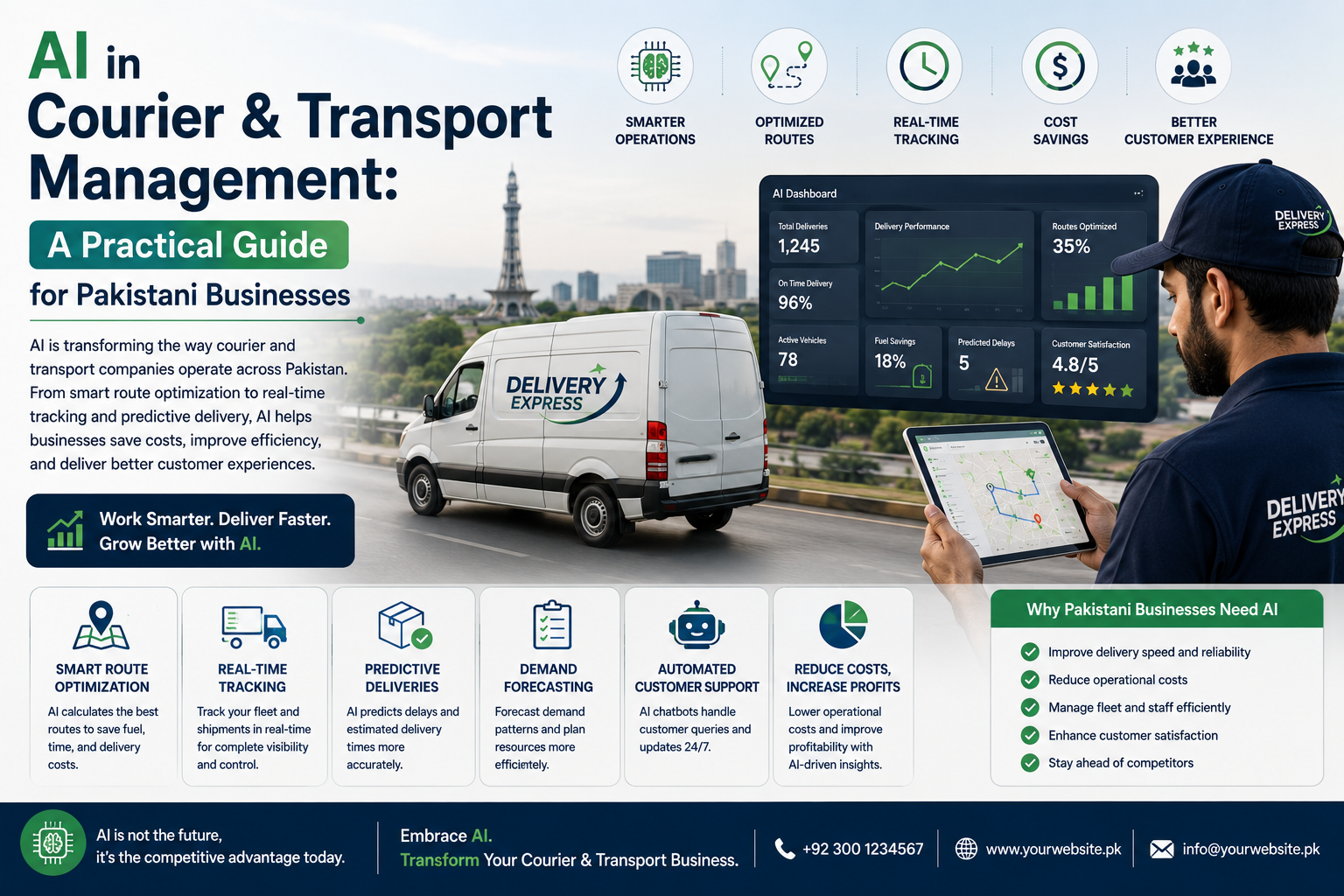
Pakistan's courier and logistics industry is growing fast on the back of e-commerce — but margins remain brutally thin. Fuel prices rise every quarter, customers expect same-day delivery updates on WhatsApp, and every undelivered parcel returns as a double cost. Operators who still run dispatch from paper registers and phone calls are not just slower than competitors; they are structurally unable to see where their money leaks.
This is where a modern AI-powered transport management system in Karachi changes the economics. Instead of just recording bookings, an intelligent courier management system predicts delivery times, plans fuel-efficient routes, flags suspicious cash-on-delivery behaviour and tells managers which routes, riders and time slots actually make money. Here's a practical breakdown for Pakistani courier, transport and logistics businesses.
Why Pakistani Courier Operations Bleed Money Quietly
Ask a courier operator about profit leakage and you'll hear familiar complaints — but most can't attach numbers to them. That's exactly the problem:
- Empty return legs: Vehicles deliver outgoing parcels but come back empty because nobody tracks backhaul opportunities.
- Inefficient routes: Two riders cover overlapping streets in Gulshan while nobody covers Korangi's new sectors.
- Fuel theft & misuse: Without route-vs-fuel correlation, over-reporting of fuel consumption is nearly invisible.
- Failed delivery attempts: Every "customer not available" attempt burns rider time and fuel — and repeat attempts double it.
- COD leakages: Cash-on-delivery amounts get delayed, short-deposited or manipulated between rider handover and bank deposit.
- No performance visibility: Owners know total monthly revenue but not per-route, per-rider or per-client profitability.
Where Traditional Courier Software Stops Helping
Many Pakistani courier companies already use some booking software — usually a basic system that prints consignment notes and stores records. It digitises paperwork, but it doesn't think. It will happily assign 47 deliveries across 12 riders in whatever order they were booked, then show you yesterday's failures this morning when nothing can be done about them.
The gap between recording operations and optimising them is where traditional tools end and AI-driven systems begin. An intelligent system doesn't wait for problems to appear in reports — it prevents them at assignment time, minutes before they become expensive.
What AI Actually Does Inside a Modern Courier Management System
"AI in logistics" sounds like marketing until you break it into concrete functions. These are the five that deliver measurable ROI for Pakistani operators:
1. Delivery Route Optimization
The system clusters daily bookings geographically and sequences each rider's stops for minimum distance — accounting for one-way streets, traffic patterns by time of day, and parcel priority. Operators typically see 15–25% fuel savings within weeks simply from smarter stop ordering.
2. Live ETA Prediction
Instead of vague "today" promises, the system calculates realistic delivery windows per parcel using historical zone speeds, current traffic and pending load — then sends customers proactive WhatsApp updates. Fewer inbound "kahan pohnchi meri cheez?" calls, fewer failed attempts from absent customers.
3. COD Fraud Detection
Machine learning models flag suspicious patterns: riders whose deposits are consistently short by small amounts, bookings with abnormal return rates, or address clusters where "refused by customer" happens suspiciously often. Each flag is a potential recovery of thousands of rupees.
4. Fleet Maintenance Forecasting
By analysing mileage, engine hours and repair history, the system predicts which bike or van needs servicing before it breaks down mid-route. Emergency breakdowns cost far more than scheduled maintenance — both in repairs and in cancelled deliveries.
5. Demand & Capacity Forecasting
Eid, sales seasons, and monsoon disruptions follow patterns. AI models trained on your historical volumes forecast next week's booking surge by zone, so you hire temporary riders and pre-position vehicles instead of drowning in backlog.
Must-Have Features of an AI-Powered TMS in Pakistan
When evaluating a courier management system in Pakistan, ensure these capabilities are included rather than sold later as add-ons:
- Booking-to-doorstep tracking with branded customer-facing status pages
- Rider mobile app — proof-of-delivery photos, digital signatures, offline mode for low-network areas
- WhatsApp integration — booking confirmations, out-for-delivery alerts, delivery proofs
- COD ledger — rider-wise cash custody, deposit reconciliation, shortage alerts
- Multi-city franchise module — head office sees everything; franchises see only their scope
- Client portal — corporate shippers book bulk consignments and pull their own reports
- Rate & weight engine — automatic freight calculation including fragile, fuel-surcharge and remote-area rules
- Accounting exports — daily ledgers that drop straight into your existing books
Manual Dispatch vs GPS Tracking vs AI Transport System
| Capability | Manual Dispatch | Basic GPS Tracking | AI-Powered TMS |
|---|---|---|---|
| Consignment recording | Paper registers | Digital booking | ✅ Digital + auto-tagged |
| Route planning | Rider's own memory | ❌ None — just live location | ✅ Optimized sequences |
| Customer ETA | Vague promises | ❌ None | ✅ Live predicted windows |
| COD control | End-of-day totals only | Limited | ✅ Real-time fraud flags |
| Fuel analysis | ❌ None | Distance only | ✅ Route-vs-consumption correlation |
| Breakdown prevention | After failure | ❌ None | ✅ Predictive maintenance |
| Profitability reporting | Monthly guesswork | Basic distance reports | ✅ Per-route, rider & client P&L |
Note the middle column carefully: GPS tracking alone shows you where vehicles are, but never tells you what to change. That's the difference between watching operations and improving them.
Eid Peak Season: A Karachi Courier Case Example
Consider a typical mid-size Karachi courier operation: 25 riders, three hub offices, heavy e-commerce COD volume. In previous Eid seasons, booking volumes nearly doubled within ten days — and so did chaos. Parcels piled up at hubs, customers complained, riders worked overtime, and roughly 8–10% of parcels required second delivery attempts.
After moving to an AI-assisted system, the following Eid cycle looked different. Demand forecasts flagged the surge two weeks early, letting the owner contract six temporary riders in advance. Daily route optimization absorbed higher volumes without extra fuel spend. Proactive WhatsApp ETAs cut failed first attempts to under 4%. The owner's summary afterwards: "Same city, same riders — the difference was that decisions were being made by data at 7 AM instead of arguments at 11 AM."
COD Fraud and Reconciliation — The Silent Profit Killer
Cash-on-delivery dominates Pakistani e-commerce, and it creates the industry's most abused workflow: rider collects cash → deposits to hub → hub deposits to bank → accounts reconcile against bookings. At any gap in that chain, money quietly disappears through short deposits, delayed banking, or outright manipulation.
An AI-enabled system enforces a tight digital custody chain: every collection is logged rider-wise with timestamped proof of delivery, expected deposit amounts update in real time, and any variance triggers an alert before week-end reconciliation turns it into an unrecoverable mystery. Operators who tighten COD controls typically recover more money in the first quarter than the software itself costs.
For cross-border and export-linked shipments, customs paperwork delays create another silent cost. Systems that maintain complete digital documentation trails help operations teams stay audit-ready — requirements published publicly by Pakistan's Federal Board of Revenue (FBR) continue to expand toward digital record-keeping, and courier companies serving exporters feel this pressure first-hand.
What Does Courier Management Software Cost in Pakistan?
Realistic 2026 market ranges for Pakistani operators:
- Small fleets (up to 10 riders): PKR 25,000–60,000/month cloud subscription depending on parcel volume
- Mid-size operations (10–50 riders, multi-hub): PKR 60,000–150,000/month including rider apps and client portals
- Custom-built systems (franchise modules, unique rate engines, ERP/accounting integrations): typically PKR 500,000–1,500,000 development with annual support contracts
Benchmark any quote against three recoverable losses: fuel wasted on inefficient routes, failed second attempts, and COD reconciliation gaps. Most mid-size operators find those three alone justify the investment within months — faster deliveries and happier corporate clients are upside on top.
Frequently Asked Questions
Will route optimization work in Karachi's unpredictable traffic?
Yes — precisely because of it. Modern systems learn zone-wise speed patterns from your own historical delivery data rather than relying only on generic maps, so routes reflect actual ground reality like Shahrah-e-Faisal jams or evening congestion around markets.
Do riders need expensive smartphones for the system to work?
No. Rider apps are built lightweight to run on budget Android phones, include offline modes for weak-network areas, and sync automatically once connectivity returns.
Can the system handle franchise-based courier networks?
A properly built web application from an experienced Pakistani development team includes multi-tenant franchise modules — head office controls rates and visibility while franchises operate their own bookings, riders and COD ledgers independently.
How long does implementation take for an operating courier company?
Small single-hub setups go live in 2–3 weeks including rider training. Multi-hub or franchise rollouts typically take 4–8 weeks, with hubs migrated one at a time so operations never stop.
Can it integrate with e-commerce platforms our clients use?
Yes — API integrations with Shopify, WooCommerce and local marketplaces let corporate clients push orders directly into your system, eliminating manual re-entry errors and speeding up same-day pickups.
What happens to my historical booking data during migration?
Established providers migrate customer masters, rate structures and at least 12 months of booking history so AI forecasting starts with real context instead of learning from zero. Confirm migration support in writing before signing any contract.
Is my business data secure on a cloud system?
Reputable systems encrypt data in transit and at rest, run automated backups, restrict role-based access, and provide data export rights. Ask vendors directly about backup frequency, server location and exit terms.
