1. Why Schools in Pakistan Still Struggle with Manual Attendance
Walk into any school in Karachi, Lahore, or Islamabad during the first period and you will see the same scene: a class teacher calling out roll numbers while a student monitors quietly copy names into a register. It takes five to ten minutes per class, twice a day — and for a school with thirty classes, that adds up to hours of teaching time lost every single morning.
Manual attendance does not just waste time. It creates problems that principals deal with every term:
- Proxy attendance: students answer for absent friends, and the register rarely catches it.
- Lost or damaged registers: a single missing notebook wipes out weeks of records.
- Delayed parent communication: parents find out about absence days later, usually after repeated calls.
- Manual data entry errors: monthly reports are compiled by hand, inviting mistakes in percentages and fee-linked attendance records.
Technology has offered partial fixes before. Fingerprint machines reduced proxy attendance but created new problems: children with sweaty hands or small fingers get rejected repeatedly, queues form at the machine, and devices fail during Karachi's humid summer months. RFID cards are easier but can be swapped between students — defeating the entire purpose.
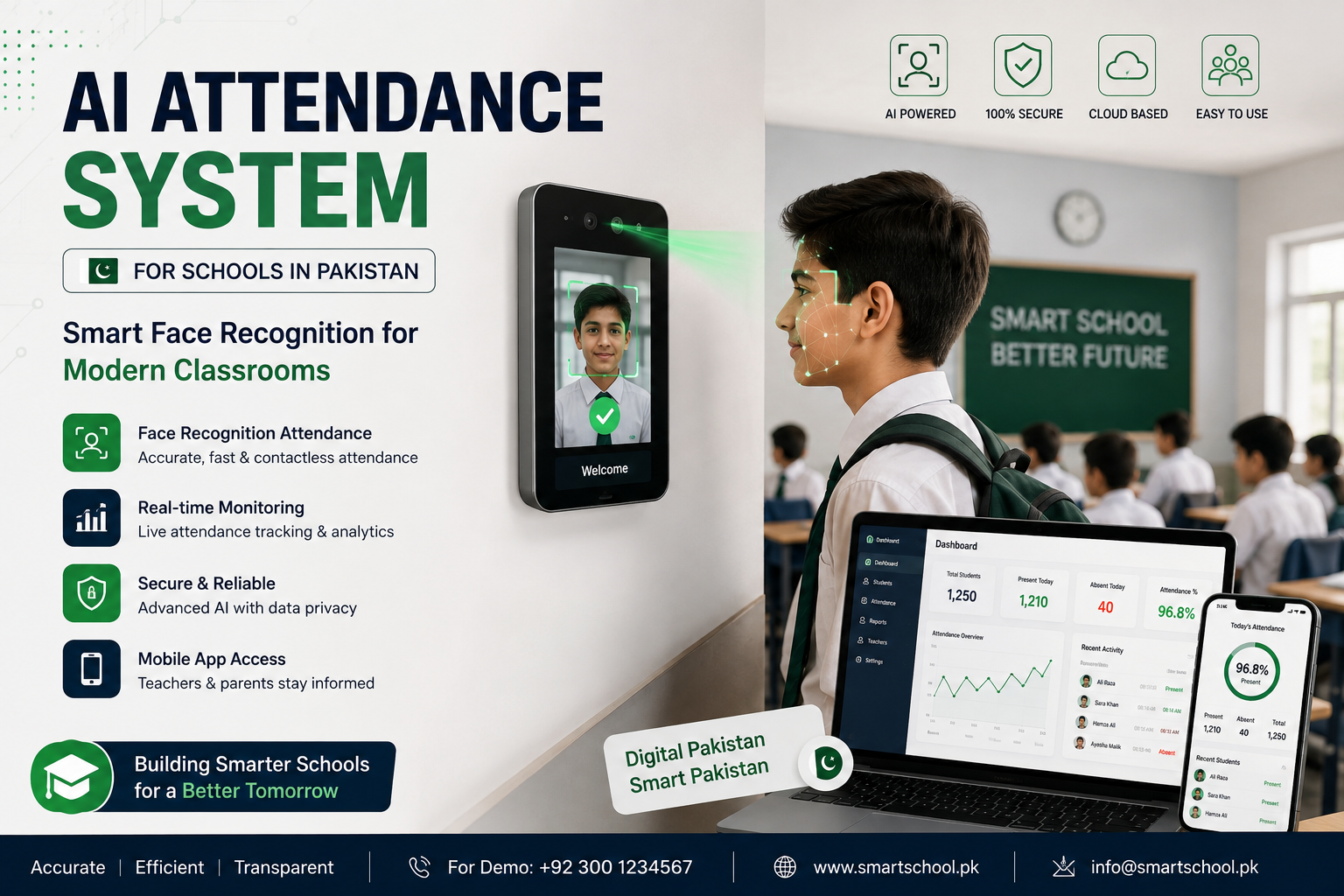
This is why an increasing number of private schools across Pakistan are moving to the next step: an AI attendance system for schools that recognises each student's face in under a second and marks attendance automatically. No cards, no fingerprints, no registers.
2. What Is an AI Attendance System for Schools?
An AI school attendance system uses facial recognition technology to identify students and staff as they enter the classroom or school gate, then automatically records their attendance in a digital database. The system captures an image, compares the face against the enrolled records, and logs the entry — all in less than one second.
Unlike older biometric systems that rely on physical contact, face recognition attendance is contactless. Students simply walk past a camera. There is no queue, no physical token, and nothing to forget at home.
A complete AI attendance solution for a school typically includes:
- Enrollment module: student photos are registered once at admission time.
- Recognition engine: the AI model identifies faces even with masks, glasses, or changed hairstyles (modern systems handle these variations).
- Attendance dashboard: real-time records, daily registers, and monthly reports for teachers and admin.
- Parent notification: automatic WhatsApp or SMS alerts when a child enters or misses school.
- Integration with the school management system: attendance feeds directly into fee reports, report cards, and exam eligibility checks.
For Pakistani schools, the best implementations run the recognition engine on-premise or on a local edge device, so the system keeps working even during internet outages and load-shedding — a critical requirement that any serious provider must address.
3. How Face Recognition Attendance Works – Step by Step
Schools do not need to understand neural networks to benefit from them, but knowing the workflow helps administrators plan the rollout:
Step 1: Enrollment
Each student's face is captured once — usually with a single photo taken at admission or during a dedicated setup week. The system converts the face into a mathematical template and stores it securely. One photo is enough; no repeated scans are required.
Step 2: Detection at Entry
A camera placed at the school gate, classroom door, or bus entrance captures students as they arrive. The AI detects a face in the frame, isolates it, and matches it against the enrolled templates.
Step 3: Automatic Marking
On a match, attendance is marked instantly with a timestamp. Unrecognised faces are flagged for the security desk — which also serves as an access-control layer for visitors.
Step 4: Live Dashboards & Reports
Teachers see a live count on their dashboard. Admin generates daily, weekly, and monthly reports in one click — including late arrivals, absentees, and attendance percentages per class.
Step 5: Parent Alerts
Parents receive an automatic message when their child arrives and another if no arrival is detected by a set time. For parents in Pakistan's dual-income families, this single feature is often the reason they choose an AI-enabled school.
💡 Real-world example: A 1,200-student school in DHA Karachi that switched from registers to face recognition reported that morning assembly now starts 12–15 minutes earlier, and the attendance clerk's entire day of register-entry work was replaced by a single dashboard check. (Insert your own school's before/after numbers here when available — real case studies are the strongest proof.)
4. Key Benefits: What Pakistani Schools Actually Gain
⏱️ 1. Teaching Time Is Recovered
Five minutes saved per class, twice a day, over 180 school days, means roughly 30 hours of teaching time recovered per class per year. That is almost a full week of lessons — with zero extra staff.
🚫 2. Proxy Attendance Becomes Impossible
A face cannot be lent to a friend. Anti-spoofing (liveness detection) also blocks photos or videos held up to the camera — a trick students try surprisingly often.
📊 3. Accurate Data for Fees & Report Cards
In many Pakistani schools, attendance percentage affects fee concessions, sports eligibility, and exam seating. AI-generated records remove disputes between parents and administration because the data is timestamped and tamper-proof.
📱 4. Parent Trust Through Instant Notifications
"Did my child reach school safely?" is a daily worry for working parents. Automatic arrival alerts — delivered over WhatsApp, which virtually every parent in Pakistan already uses — build trust that no brochure can match.
🛡️ 5. Gate-Level Security
Because the same system flags unrecognised faces, it doubles as an entry-security layer. Schools can link it to an automated gate so only enrolled students and staff enter.
📈 6. Data-Driven Decisions for Management
Patterns emerge that registers hide: which periods have the highest absenteeism, which days parents pull children out, which classes have chronic latecomers. Management can act on trends instead of anecdotes.
5. AI Attendance vs. Manual, Fingerprint & Card Systems
| Feature | Manual Register | Fingerprint | RFID Card | AI Face Recognition |
|---|---|---|---|---|
| Time per student | 5–10 sec | 2–4 sec | 1–2 sec | <1 sec (walk-past) |
| Proxy attendance risk | High | Low | High (cards shared) | Negligible |
| Contact/hygiene | N/A | Contact required | Contact optional | Fully contactless |
| Works during power/internet outage | Yes | Yes (standalone) | Needs power | Yes — with on-premise AI |
| Reports & parent alerts | Manual only | Basic | Basic | Automatic, real-time |
| Maintenance over time | Repurchase registers | Sensor wear, cleaning | Lost/replaced cards | Minimal — software updates |
| Integration with school ERP | No | Limited | Limited | Full integration |
The pattern is clear: every older method solves one problem while creating another. Face recognition is the only option that addresses speed, accuracy, security, and reporting at the same time.
6. Privacy & Data Security: Staying Compliant in Pakistan
Facial data is personal data, and schools have a legal and ethical duty to protect it. Pakistan's Personal Data Protection Act 2023 establishes clear obligations for organisations that collect and process personal information — including biometric data. A responsible AI attendance deployment should follow these principles:
- Informed consent: parents sign consent at admission clearly stating how attendance data is used and stored.
- Purpose limitation: facial data is used only for attendance and security, never sold or shared with third parties.
- Secure storage: templates are encrypted; on-premise storage is preferable to cloud-only storage.
- Access control: only authorised staff can view or export attendance records.
- Deletion policy: data is automatically deleted when a student leaves the school.
🔐 Data protection checklist: Before signing with any attendance vendor, ask: Where is the data stored? Who has access? Is encryption used? Can we export our data anytime? What happens to data when a student leaves? A vendor that answers these questions clearly is a vendor worth trusting.
Schools that demonstrate privacy compliance also gain a marketing advantage. In an era when parents read about data leaks in the news, "your child's data is protected on school premises" is a powerful admission-season message.
7. How to Choose the Right AI Attendance System
Not every "AI attendance system" on the Pakistani market is equal. Some are thin wrappers over cloud APIs that stop working when the internet drops. Use this checklist during vendor evaluation:
- Offline capability: the system must recognise faces and mark attendance even with no internet. This is non-negotiable in Pakistan.
- Anti-spoofing: verify that the system detects photos and videos (liveness detection).
- Accuracy on children: children's faces change as they grow; the system should re-enroll or update templates periodically.
- Language support: dashboards and reports in English and Urdu for admin and staff comfort.
- School ERP integration: attendance must feed into the school's fee, exam, and report-card modules automatically, not through manual exports.
- Hardware requirements: check camera quality needs and whether an on-premise unit (NUC/edge device) is included.
- Support & training: does the vendor train staff and offer local support in Pakistan? A system without local support is a liability.
- Transparent pricing: one-time license vs. per-student-per-year pricing; watch for hidden hardware or maintenance costs.
If you already use a school management system in Pakistan for admissions, fees, and report cards, choose an attendance module that integrates with it — a fragmented setup (attendance in one software, fees in another) recreates the very manual work AI was meant to remove.
8. Frequently Asked Questions
Q1: Is face recognition attendance legal in Pakistan?
Yes. Schools can use biometric and facial recognition attendance provided they follow data-protection obligations — informed parental consent, secure storage, and limited use. Aligning with the Personal Data Protection Act 2023 keeps the school compliant.
Q2: What happens during power cuts or internet outages?
A well-designed system runs the AI engine on an on-premise device with a small UPS, so attendance continues during load-shedding. Records sync automatically once connectivity returns. Always confirm offline mode with the vendor before purchase.
Q3: Can students cheat with a photo of a classmate?
Modern systems include liveness detection that distinguishes a live face from a printed photo or phone screen. Combined with walk-past cameras monitored by staff, this makes proxy attendance effectively impossible.
Q4: How long does the system take to identify each student?
Recognition typically takes under one second per student, and because multiple students can be captured in a single frame, the whole class can be marked by simply walking past the camera — no queueing required.
Q5: What happens to student data after they leave the school?
Reputable systems automatically delete facial templates and records after a student graduates or transfers, in line with data-protection principles and the school's retention policy.
Q6: How much does an AI attendance system cost in Pakistan?
Costs vary with school size, hardware, and whether the software is cloud or on-premise. Budget for three components: cameras, the recognition unit/software license, and annual support. Schools of 500–2,000 students typically recover the investment within a year through saved staff time and reduced proxy-related fee losses.
Q7: Can the system integrate with our existing school software?
Yes — a quality attendance solution exposes APIs and integrates with school management systems. This is where Global Dezigns' experience matters: attendance should flow automatically into fee, exam, and report-card modules instead of living in a separate silo.
9. Conclusion: Is Your School Ready?
Manual attendance is not just outdated — it is expensive. It costs teaching time, enables proxy attendance, delays parent communication, and produces records that are difficult to trust. An AI attendance system for schools solves all of these in one move: contactless recognition, instant reports, automatic parent alerts, and integration with the school's wider management software.
For schools in Pakistan, the winning approach is a system that works offline, protects student data, and connects with existing school operations. The technology is mature, the legal framework is clear, and the parents' expectations are already there.
View All Blogs